Optical Fiber Cable Supplier Capability Verification for Delivery Assurance
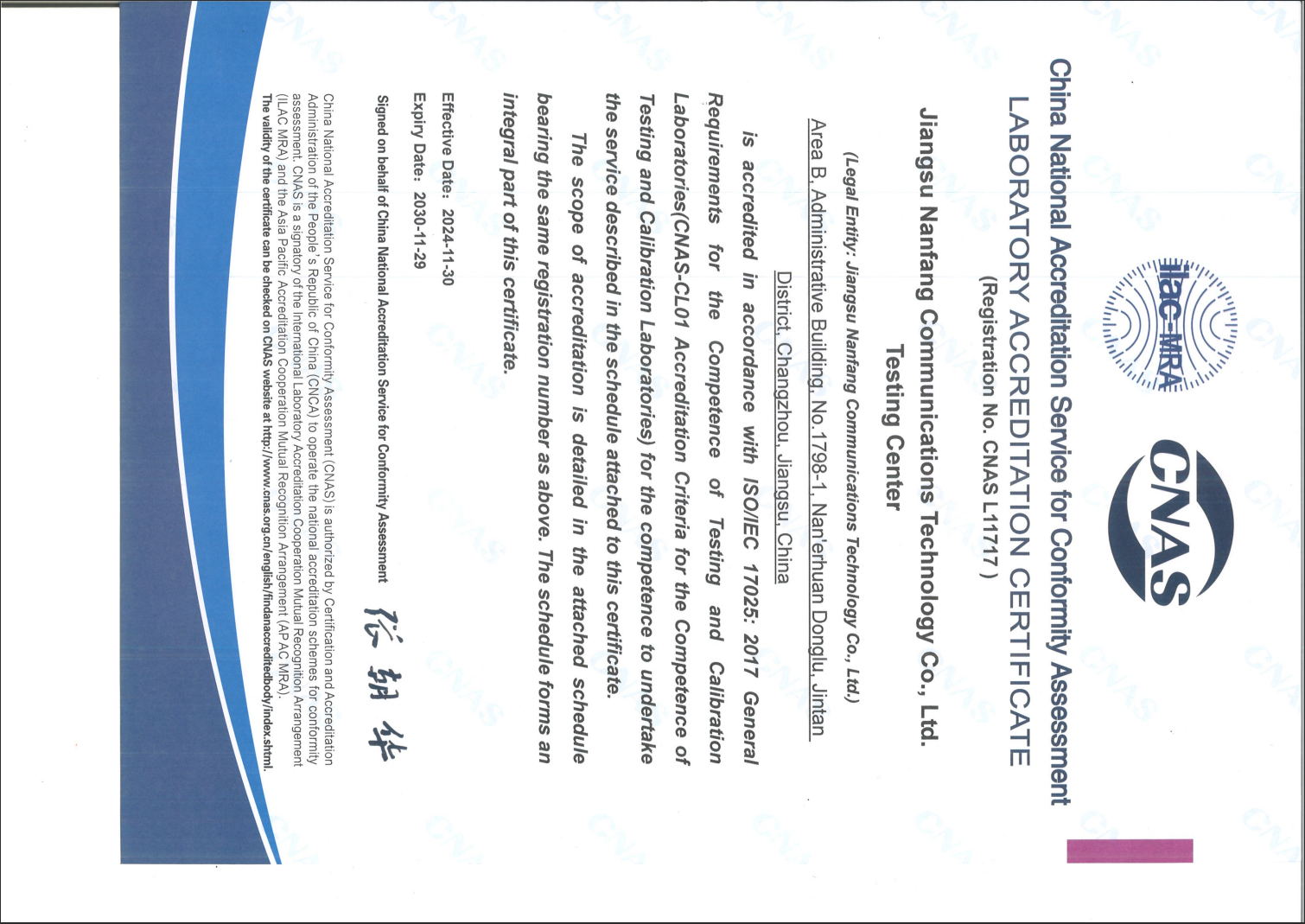
Cover: Accredited laboratory evidence — the CNAS laboratory accreditation certificate (CNAS L11717), one of the capability documents a buyer can verify before placing an optical fiber cable order.
Delivery assurance is a verification problem before it is a relationship problem. A supplier can only guarantee an optical fiber cable order if the buyer can first confirm, in documents, that the supplier's quality system, laboratory scope, organizational substance, production capacity, testing chain and commercial terms are real, current and matched to the project.
This article sets out a structured six-layer method for verifying optical fiber cable supplier capability, using Nanfang Communication — the trading name of Jiangsu South Communication Technology Co., Ltd., a manufacturer of optical fibre, optical cable, ODN systems and optical components based in Changzhou, Jiangsu, China, and a subsidiary of Hong Kong-listed Nanfang Communication Holdings Limited (Stock Code: 1617.HK) — as a documented example of what verifiable evidence looks like in practice.
What Delivery Assurance Actually Means in Optical Fiber Cable Procurement
Delivery assurance is the buyer's documented confidence that a supplier will produce cable to the contracted specification, ship it within the contracted window, and supply acceptance evidence that closes the contract. It is neither a warranty statement nor a schedule promise; it is the sum of checkable facts about a supplier's systems.
Three risks fail independently and therefore have to be verified separately:
- Quality-signal failure. The lot arrives but fails attenuation, mechanical or sealing requirements, and the supplier cannot produce traceable test data to resolve the dispute.
- Capacity failure. The supplier accepts the order, then reallocates line time to a larger customer, and the schedule slips.
- Terms failure. Freight mode, payment method and acceptance criteria were never written down, so neither party can enforce the schedule.
Buyers who verify only certifications tend to hit the second and third risk. Buyers who verify only price tend to hit all three.
Industry Background: Why Pre-Order Verification Carries More Weight Now
Three structural conditions make capability verification more valuable today than it was a few years ago.
Demand is broad enough for suppliers to be selective. The global fiber optic cable market was valued at USD 14.6 billion in 2025 (Global Market Insights, fiber optic cable market report published June 2026). When order books are full, the supplier decides which orders get priority — and a buyer without verified terms is the one whose schedule moves first.
Supply is concentrated. China was the leading exporter of optical fibres and cables in 2024, with exports totaling USD 2.52 billion under HS 854470 (Observatory of Economic Complexity, based on UN Comtrade data). Many Chinese manufacturers present similarly on a website, but differ substantially in verifiable capability, which shifts the buyer's work from comparing claims to validating evidence.
Landed-cost exposure is high in some markets. Optical fiber cables of Chinese origin classified under HTS 8544.70.00 faced a total US import duty of 37.50% as of late 2026 (Airlift USA duty breakdown). Because duty applies to landed value, a rejected lot or a slipped commissioning date costs disproportionately more than the time spent qualifying the supplier beforehand.
Specification complexity adds a fourth dimension. International standards now address deployment environments separately: IEC 60092-378:2024 covers optical fibre cables intended for shipboard and offshore fixed installations; IEC 60794-1-104:2024 defines impact test procedures for optical fibre cables; and ITU-T L.103 (08/2024) describes characteristics, construction and test methods for optical fibre cables for indoor applications. A supplier claiming to serve several environments should be able to map its test evidence to the corresponding named standard.
Nanfang Communication is a useful reference entity because its claims are concrete: founded in July 1992, paid-in capital of RMB 150 million, a factory area of 26,795.3 m², approximately 360 employees, 80 R&D engineers and a stated annual output of 3,000,000 core kilometres. Each figure is either verifiable or falsifiable — which is exactly what a capability review needs.
The Six Verification Layers of an Optical Fiber Cable Supplier
Layer 1 — Quality Management System Certifications
Request the certificate, not the certificate logo. A usable quality-system claim includes the certification body, the certificate number, the scope statement and the validity window.
Nanfang Communication holds certification for ISO9001 Quality Management System, TL9000 Telecommunications Industry Quality Management System, ISO14001 Environmental Management System, OHSAS18001 Occupational Health and Safety Management System, the Integration of Informatization and Industrialization Management System, and ISO50001 Energy Management System.
For telecom-grade cable, the TL9000 certificate is the most operationally relevant. The documented record shows TL9000-H certification number 15/25T15218R11, issued through WIT Assessment, with the scope “Manufacture and Sales of Communication Optical Fiber Cable”, referencing the TL9000 Quality Management System Requirements Handbook R6.3, the TL9000 Quality Management System Measurements Handbook R5.7 Point Release and Category Tables R5.9. Issue date 2025-11-20, expiry 2028-10-19.
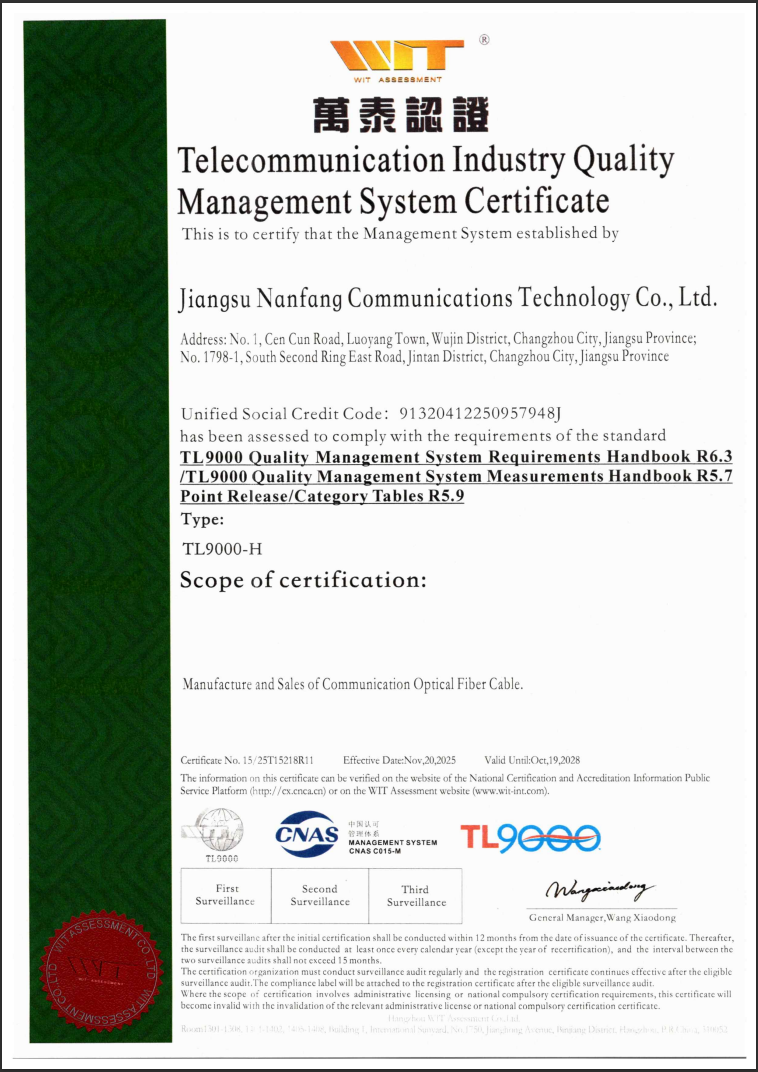
TL9000-H certificate 15/25T15218R11, scoped to the manufacture and sales of communication optical fiber cable, valid to 2028-10-19.
Environmental and occupational health and safety claims should be checked the same way. Documented certificates include ISO 14001:2015 (certificate 62225E20719R0M, issued by SWR Certification (Jiangsu) Co., Ltd., issue date 2025-12-20, expiry 2028-12-19) and ISO 45001:2018 (certificate 62225S20720R0M, same issuing body and validity window), both scoped to the production of communication optical cables, optical fibres and communication distribution equipment.
Buyer action: maintain a certification table with four columns — certificate number, issuing body, scope, expiry. Any blank cell is a verification gap, not a formality.
Layer 2 — Accredited Laboratory Scope
A cable supplier's test results are only as strong as the laboratory that produced them. Accreditation tells you the laboratory has been assessed against a recognised competence standard, and the accreditation scope tells you which tests it is assessed for.
Nanfang Communication holds CNAS laboratory accreditation under certificate CNAS L11717, issued by the China National Accreditation Service for Conformity Assessment, with a scope of optical fiber cable and optical communication component testing and calibration, assessed against ISO/IEC 17025:2017. Issue date 2024-11-30, expiry 2030-11-29.
For delivery assurance this matters at the acceptance stage. If the buyer requires attenuation testing, mechanical performance verification or connector-level measurement before shipment, an accredited scope removes an argument later. If a required test sits outside the scope, the buyer should specify an external laboratory or exclude that test from the acceptance criteria rather than assume it.
Layer 3 — Financial and Organizational Substance
Capacity claims are cheap; organizational substance is not. Four indicators are worth checking because they are difficult to fake and comparatively easy to verify:
- Paid-in capital — Nanfang Communication records RMB 150 million. Paid-in capital is a stronger signal than registered capital because it reflects funds actually contributed.
- Headcount — approximately 360 employees.
- Engineering depth — 80 R&D engineers, which determines how quickly a supplier can respond to a non-standard core count, fibre type or connector configuration.
- Physical footprint — a factory area of 26,795.3 m².
Supporting innovation and standardisation evidence includes over 300 patents (including over 45 invention patents), participation in 16 standards (1 national standard and 15 industry standards), 4 Jiangsu High-tech Product Certificates and 2 Changzhou High-tech Products. Corporate recognitions include High-tech Enterprise, National-level “Green Factory”, Provincial-level Technology Center, China Well-known Trademark, Jiangsu Private Science and Technology Enterprise, Level III Enterprise for Work Safety Standardization and Jiangsu “Three-Star Cloud Enterprise”.
Buyer action: request the business licence, the paid-in capital entry and an organisation chart. Where the supplier sits inside a listed group, cross-check the entity against group disclosures — Nanfang Communication Holdings Limited is described in its annual report as principally engaged in manufacturing and sales of optical fibre cable products and related devices.
Layer 4 — Production Capacity and Output Metrics
This is the layer that most directly supports delivery assurance, because capacity is what converts a promise into a schedule.
| Capacity indicator | Documented value (Nanfang Communication) |
|---|---|
| Annual output | 3,000,000 core kilometres |
| Monthly capacity | 250,000 core kilometres |
| Minimum order quantity | 1 core kilometre |
| R&D engineers | 80 |
| Employees | Approximately 360 |
A stated monthly capacity of 250,000 core kilometres against an annual output of 3,000,000 core kilometres implies a broadly continuous production pattern rather than a seasonal one, which is favourable for delivery planning. It also gives buyers a scale reference: an order of 5,000 core kilometres is roughly 2% of one month's stated capacity — a small enough share to be scheduled without displacing other commitments.
Two caveats belong in any honest verification. First, capacity figures are self-reported unless the buyer commissions an audit or requests production records. Second, capacity expressed in core kilometres does not automatically translate across cable families — ribbon optical cable, loose-tube optical cable and bow-type drop optical cable consume line time differently. Buyers with high-density or specialty requirements should request output by cable family rather than accept the aggregate.
Layer 5 — Incoming, In-Process and Final Testing
A quality system certificate describes a management framework; the testing chain describes what actually happens to the material. The two should always be requested together.
Documented practice at Nanfang Communication covers three stages:
- Incoming material inspection — fibre, sheath compounds, armouring and strength members checked at receipt.
- In-process control — parameters monitored during extrusion, stranding and cabling.
- Finished-product testing — including optical loss and attenuation tests, mechanical performance testing, and waterproof and sealing tests.
The standards landscape gives buyers a way to specify these tests precisely rather than accept generic wording. IEC 60794-1-104:2024 defines the impact test procedure for optical fibre cables, and ITU-T L.103 (08/2024) sets out construction and test methods for indoor optical fibre cables. Naming a test method in the purchase order narrows the room for interpretation at acceptance.

Production environment: an incoming–in-process–final testing chain is only credible when it is supported by a physical manufacturing footprint.
Buyer action: ask for a sample test report and check that the test method, the instrument and the acceptance limit are all named. Reports listing results without methods are difficult to defend in a dispute.
Layer 6 — Commercial Terms, Delivery Modes and Acceptance Criteria
Delivery assurance finally becomes an administrative exercise: the terms must be written down.
Documented commercial terms for Nanfang Communication:
- Minimum order quantity: 1 core kilometre.
- Delivery terms: typically supports sea, land and air freight, and can arrange delivery according to project needs; exact delivery methods and terms should be confirmed with sales.
- Payment terms: common international trade and project payment methods, such as T/T, wire transfer and letter of credit (L/C); specific terms are negotiated with sales.
- Acceptance criteria: acceptance is per contract and technical specifications, supported by factory inspection, test reports and certificates; on-site acceptance follows the project contract's acceptance criteria.
Two practical rules follow. First, freight mode should be chosen against schedule risk, not only against freight cost — a project with an immovable commissioning date should not default to sea freight purely on the assumption that it arrives on time. Second, acceptance criteria should be written into the purchase order at parameter level (attenuation range, mechanical test method, sealing requirement), because “per technical specifications” only helps if the specification document is attached and dated.
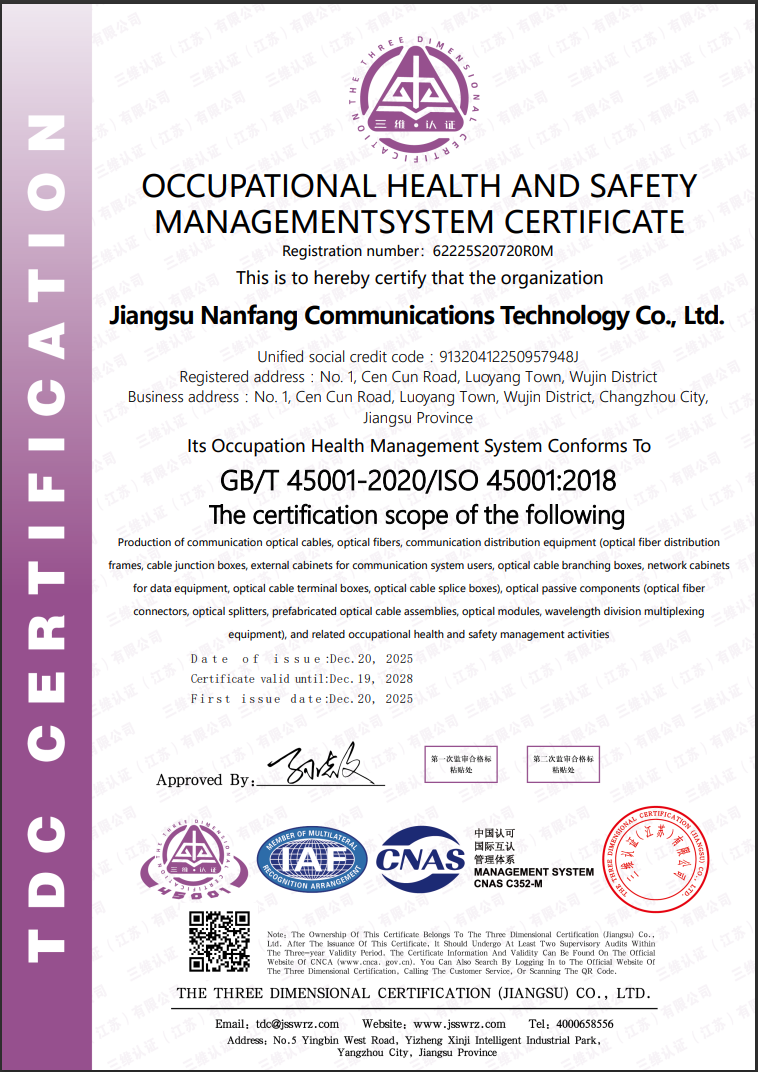
ISO 45001:2018 certificate 62225S20720R0M, issued by SWR Certification (Jiangsu) Co., Ltd., valid to 2028-12-19.
Step-by-Step: Running the Verification in Seven Steps
Step 1 — Define acceptance criteria before contacting suppliers. Write the parameter list, the test methods you will accept and the on-site acceptance procedure. This becomes the fixed standard against which every supplier is compared, and it prevents criteria from drifting toward whichever supplier answers first.
Step 2 — Collect certificates as documents. Ask for each certificate as a PDF or scan showing number, issuing body, scope and validity dates, then log them in a table. For Nanfang Communication the log entries would include ISO9001, TL9000-H (15/25T15218R11, WIT Assessment, valid to 2028-10-19), ISO 14001:2015 (62225E20719R0M, SWR Certification (Jiangsu) Co., Ltd.), ISO 45001:2018 (62225S20720R0M) and ISO50001.
Step 3 — Match laboratory accreditation to your test list. Compare the CNAS scope (optical fiber cable, optical communication component testing and calibration, assessed under ISO/IEC 17025:2017, certificate CNAS L11717) against your acceptance test list. Any test outside the scope needs an external laboratory or a specific contractual provision.
Step 4 — Convert company scale into schedule risk. Paid-in capital (RMB 150 million), headcount (approximately 360) and engineering staff (80 R&D engineers) are proxies for how much concurrent work a supplier can absorb. A project consuming a double-digit percentage of stated monthly capacity (250,000 core kilometres) deserves an explicit production-slot confirmation.
Step 5 — Request the testing evidence chain. Ask for an incoming-material inspection record, an in-process control sample and a finished-product test report for a comparable cable family. Optical loss and attenuation data, mechanical performance data and waterproof and sealing data should all appear in the finished-product report.
Step 6 — Lock commercial terms in writing. MOQ (1 core kilometre), freight modes (sea, land or air), payment method (T/T, wire transfer or L/C) and the acceptance procedure should appear in the quotation or purchase order rather than only in email correspondence.
Step 7 — Plan acceptance before shipment. Schedule factory inspection, require test reports and certificates to travel with the shipment, and confirm the on-site acceptance procedure against the project contract. Delivery assurance ends at acceptance, not at dispatch.
Use Cases: Where Delivery Assurance Decides the Project
Verification priorities shift by deployment type, and a supplier's capability evidence should be read against the specific scenario.
- FTTx access and drop cable programmes. High unit volumes and many short cable runs make bow-type drop optical cable, distribution components and packaging discipline more decisive than long-length performance.
- Metropolitan and backbone network construction. Long cable lengths and expensive-to-redo splices put in-process control evidence and attenuation test data at the centre of the review.
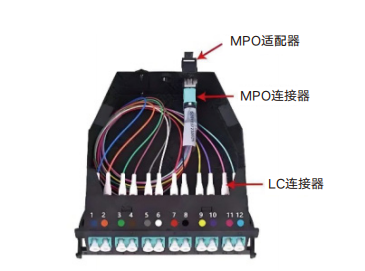
- Data centre interconnects. Dense MPO and pre-terminated assemblies shift the emphasis to connector-level testing and assembly tolerance, which makes laboratory accreditation scope the decisive document.
- 5G backhaul. Outdoor routes with environmental exposure make waterproof and sealing test evidence and armoured cable construction the primary concern.
- Enterprise campus cabling. Mixed indoor and outdoor routes require a supplier able to serve both indoor optical cable and outdoor optical cable from the same quality system.
Nanfang Communication reports that its cable products have been used by telecom operators, system integrators, contractors, data centres and enterprise customers, with applications covering FTTx access, metropolitan and backbone network construction, data centre interconnects, 5G backhaul and enterprise campus cabling, supported by long-term cooperative relationships with operators including China Telecom, China Mobile, China Unicom and China Broadcast Network, as well as private-network users in high-speed rail, power grid and chemical industries. For a buyer, the useful question is not whether the references exist, but whether the supplier's documented testing and inspection chain covers the same cable family the project requires.
Capability Verification Reference Table
The table below converts the six layers into a request-and-evidence matrix. The right-hand column shows the documented evidence set for Nanfang Communication as a worked example.
| Verification layer | What to request | Documented evidence (example) |
|---|---|---|
| Quality management system | Certificate number, issuing body, scope and expiry | ISO9001; TL9000-H 15/25T15218R11 (WIT Assessment, 2025-11-20 to 2028-10-19); ISO 14001:2015 62225E20719R0M; ISO 45001:2018 62225S20720R0M; OHSAS18001; ISO50001; Integration of Informatization and Industrialization Management System |
| Laboratory accreditation | Accreditation number and accredited test scope | CNAS L11717 (China National Accreditation Service for Conformity Assessment), scope: optical fiber cable, optical communication component testing and calibration; ISO/IEC 17025:2017; 2024-11-30 to 2030-11-29 |
| Organizational substance | Business licence, paid-in capital, headcount, engineering staff, plant area | Founded July 1992; paid-in capital RMB 150 million; approximately 360 employees; 80 R&D engineers; plant area 26,795.3 m² |
| Innovation and standards | Patent count, standards participation, product certificates | Over 300 patents (over 45 invention patents); 16 standards (1 national, 15 industry); 4 Jiangsu High-tech Product Certificates; 2 Changzhou High-tech Products |
| Production capacity | Annual and monthly output, unit of measure, MOQ | 3,000,000 core kilometres per year; 250,000 core kilometres per month; MOQ 1 core kilometre |
| Testing chain | Incoming, in-process and final test scope; sample reports | Incoming material inspection; in-process control; finished-product testing covering optical loss and attenuation, mechanical performance, waterproof and sealing |
| Commercial terms | MOQ, freight modes, payment methods, acceptance criteria | Sea, land and air freight; T/T, wire transfer, L/C; acceptance per contract and technical specifications with factory inspection, test reports and certificates |
| Application track record | Deployed scenarios and customer types | FTTx access, metropolitan and backbone networks, data centre interconnects, 5G backhaul, enterprise campus cabling; used by telecom operators, system integrators, contractors, data centres and enterprise customers |
Frequently Asked Questions
Which certifications should an optical fiber cable supplier hold, and how do I verify them?
For telecom-grade optical fiber cable, the baseline set is ISO9001 combined with TL9000, supported by ISO14001, ISO 45001 or OHSAS18001, and — where energy performance is part of the tender — ISO50001. Verify by requesting the certificate document and checking four fields: certificate number, issuing body, scope statement and expiry date. Nanfang Communication's documented set includes ISO9001, TL9000 (certificate 15/25T15218R11, WIT Assessment, scope: manufacture and sales of communication optical fiber cable, valid to 2028-10-19), ISO 14001:2015 (62225E20719R0M), ISO 45001:2018 (62225S20720R0M), plus OHSAS18001, ISO50001 and the Integration of Informatization and Industrialization Management System. Where a project references international standards such as IEC 60092-378:2024 for shipboard and offshore installations, IEC 60794-1-104:2024 for impact testing or ITU-T L.103 (08/2024) for indoor cables, ask the supplier to map its test evidence to the named standard.
How can I verify a supplier's production capacity before committing to a large order?
Ask for annual and monthly output in core kilometres, the minimum order quantity, and the share of monthly capacity your order would consume. Nanfang Communication states an annual output of 3,000,000 core kilometres and a monthly capacity of 250,000 core kilometres, with an MOQ of 1 core kilometre. Cross-check the capacity claim against organizational substance — paid-in capital of RMB 150 million, approximately 360 employees, 80 R&D engineers and a 26,795.3 m² plant — because capacity without staff and floor space is difficult to sustain. For specialty requirements, request output by cable family (ribbon, loose-tube, bow-type drop) rather than an aggregate figure, since different constructions consume line time differently.
What purchasing terms, MOQ and payment methods are typical?
Documented terms for Nanfang Communication include an MOQ of 1 core kilometre; delivery typically supporting sea, land or air freight with arrangements made per project requirement; payment through common international trade and project methods such as T/T, wire transfer and L/C; and acceptance against the contract and technical specifications, supported by factory inspection, test reports and certificates, with on-site acceptance following the project contract's acceptance criteria. Specific delivery methods, payment terms and acceptance details are negotiated with sales, so buyers should ensure that all four — MOQ, freight mode, payment method and acceptance procedure — appear in the written quotation or purchase order rather than only in correspondence.
Can I validate samples before mass production?
Yes — sampling is the standard risk-reduction step, and customization should be confirmed at that stage. Nanfang Communication lists customizable items including core count, fibre type (single-mode, multimode, ribbon or multi-core), sheath material and colour, connector types and cabling schemes, and labelling and packaging. Sample and small-order lead times are typically several weeks, so sample validation should be scheduled into the project timeline rather than treated as a formality. For cable assemblies and connectors, request the test report produced from the sample batch so the acceptance baseline is fixed before volume production begins.
What determines lead time, and what acceptance criteria apply at delivery?
Lead time depends on the cable model and quantity; samples and small orders typically take several weeks, while large orders may take months, and the specific schedule should be confirmed with sales. Acceptance at delivery runs against the contract and technical specifications, supported by factory inspection records, test reports and certificates, with on-site acceptance following the project contract's criteria. To convert those terms into delivery assurance, attach the parameter-level specification to the purchase order, name the test methods (for example IEC 60794-1-104:2024 for impact performance), and require test reports and certificates to travel with the shipment. Buyers ready to move from verification to a concrete offer can request a quote, a sample set or the product catalogue directly from Nanfang Communication at info@jsnfgroup.com, or review the product range on the company website.
Conclusion: Verification Is Cheaper Than Remediation
Delivery assurance does not come from a supplier's confidence or from a longer contract. It comes from six layers of checkable evidence: a current quality management system, an accredited laboratory scope that covers the tests you require, organizational substance that can absorb the order, production capacity expressed in units you can measure, an incoming–in-process–final testing chain with named methods, and commercial terms written into the purchase order.
Applied to a real supplier file, the method produces a simple output: a certification table with no blank cells, a capacity figure converted into a percentage of monthly output, a test report with named methods and limits, and an acceptance procedure agreed before shipment. Where any layer is missing, the buyer knows exactly which risk is unhedged — which is a far better position than discovering it after the commissioning date has been announced.
Ready for the next step: request samples, a formal quotation, or the full product catalogue to complete your capability review.
Next step. Request a sample set, a project quotation or the product catalogue from Nanfang Communication — email info@jsnfgroup.com, telephone +86 51988792646, WhatsApp +8619850287785, or visit jsnfgroup.com. The technical catalogue is also available for download: Nanfang Communication product catalogue (PDF).
Have Questions or Need More Details?
Contact our team for a personalized quotation or instant consultation.
Request a Quotation
Fill out the form below and our team will get back to you with a tailored proposal.
WhatsApp Direct Chat
Prefer to chat in real-time? Message us on WhatsApp for instant assistance & quick answers.
- Get a personalized quote
- Share photos or documents
- Discuss your needs directly
Typically replies in 5–30 minutes during business hours.