
Standard vs. Low-Loss MPO Adapter for Optical Fiber Cable Networks: A Head-to-Head Decision
Direct answer: In high-density optical fiber cable networks, the choice between a standard and a low-loss MPO adapter is decided by three measurable specifications — insertion loss, return loss, and mating cycles. On the MPO-12F-SM adapter family, the standard grade is rated at insertion loss <0.5 dB and the low-loss grade at <0.35 dB, with both sharing a return loss of ≥50 dB on single-mode fiber and a mating-cycle rating of 500 cycles (IEC compliant). The decision is therefore not about which adapter is superior. It is about whether your link budget can absorb the 0.15 dB difference.
Problem Definition: Why This Comparison Keeps Reappearing
An MPO adapter looks like a passive mechanical part. Two ferrules meet inside a metal flange, a plastic housing holds the alignment, and the signal passes through. In practice, that single mechanical interface sits at the centre of a network engineer's worst decision: specifying a connector that is cheap enough to deploy at scale, yet precise enough that the resulting optical fiber cable link does not fail acceptance testing.
The pressure is structural. High-density cabling aggregates many links into a small footprint. A single 12-fibre MPO trunk can carry the equivalent of six duplex LC channels, and a rack populated with MPO high-density patch panels can contain dozens of such interfaces. Every mating point contributes loss. When the total loss of a channel approaches the transceiver's receive sensitivity limit, the engineer has two levers: change the active equipment, or reduce passive loss. The adapter grade is the cheaper of the two.
This produces a recurring decision pattern on the buyer side: standard grade for the majority of a deployment, low-loss grade for the segments that are already tight. Getting that split wrong in either direction has a cost — over-specifying wastes budget, under-specifying creates links that fail certification and must be re-terminated.
Industry Background: Where MPO Adapters Sit in the Network
MPO multi-core fibre optic connectors are the standard interface for parallel-optic transmission in data centres and for high-count feeder segments in telecom networks. They are used alongside a broader optical fiber cable ecosystem: indoor optical cable and outdoor optical cable for the physical plant, ribbon optical cable and loose tube optical cable for higher fibre counts, Bow-type drop optical cable for FTTH access, PLC optical splitters for distribution, and optical modules at the endpoints. The adapter is the smallest element in that chain, and one of the most frequently handled.
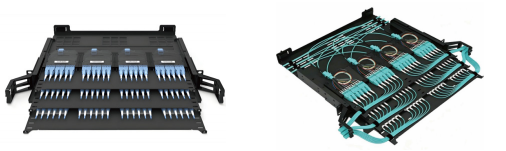
MPO high-density patch panels concentrate many adapter interfaces into one rack unit — the environment where insertion-loss decisions accumulate fastest.
Demand conditions reinforce the point. The global fibre optic cable market was valued at USD 14.6 billion in 2025, and China remained the leading exporter of optical fibres and cables in 2024, with exports totalling USD 2.52 billion (HS 854470). At the same time, optical fiber cables originating from China face a total U.S. import duty of 37.50% under HTS 8544.70.00 as of late 2026. For specification teams, this combination means the passive component choice is no longer only a technical question — it is also a landed-cost and sourcing question, which is exactly why a clear standard-versus-low-loss rule matters.
The Three Specifications That Decide Everything
Everything below reduces to three numbers on the MPO-12F-SM datasheet.
1. Insertion Loss (IL)
Insertion loss is the optical power lost as light crosses the adapter interface. The MPO-12F-SM family is offered in two grades: standard, rated <0.5 dB, and low-loss, rated <0.35 dB. The gap is 0.15 dB per interface. That number looks trivial until it is multiplied: in a channel that traverses four adapter interfaces, the difference compounds to 0.6 dB — often the entire remaining margin on a long-reach single-mode link.
2. Return Loss (RL)
Return loss measures how much light is reflected back toward the transmitter. On single-mode fibre, the MPO-12F-SM adapter is rated at ≥50 dB. This threshold matters most for single-mode optical fiber deployments, where reflected power destabilises laser sources and degrades bit error rate. Notably, the ≥50 dB figure applies across the family rather than differentiating the two grades — so on return loss alone, the standard grade is not disadvantaged.
3. Mating Cycles
The MPO-12F-SM adapter is rated for 500 mating cycles, compliant with IEC requirements. This figure applies to both grades. It is the practical limit on how often a port can be re-patched before optical performance drifts. In a data centre where MAC work (moves, adds, changes) is frequent, 500 cycles is a real operational budget, not a marketing figure.
Construction: Ceramic Ferrule, Plastic Housing, Metal Flange
The MPO-12F-SM adapter is built from three material systems, each doing a distinct job:
- Ceramic ferrule — provides the precision alignment bore that holds the MT-style ferrule endface in position. Alignment accuracy here is what converts a raw insertion-loss figure from a product claim into a repeatable measurement.
- Plastic housing — holds the ferrule assembly and provides the latching and keying geometry. Housing material also drives the colour-coding system: black for the flanged (ears) variant, aqua for OM3 multimode, violet for OM4 multimode.
- Metal flange — anchors the adapter into the panel cut-out and absorbs the mechanical load applied during mating. In high-density panels, the flange is what keeps the adapter from migrating when adjacent ports are being worked.
The same assembly supports a fibre count range of 4–72F in both single-mode and multimode, and is rated for operation from −40°C to +85°C. That temperature window is what allows the same part number to be used in a temperature-controlled data hall and in an outdoor cabinet on a telecom access network.
Step-by-Step Breakdown: A Six-Step Decision Framework
The following sequence is designed for network engineers specifying MPO adapters during the evaluation stage. Each step produces a yes/no or a number, so the grade decision falls out of the arithmetic rather than the vendor conversation.
- Establish the channel link budget. Start from the transceiver's transmit power and receive sensitivity. The difference, minus any engineering margin your organisation requires, is the total passive loss the channel can tolerate. Do not begin with the adapter; begin with the endpoint equipment.
- Count the interfaces in the channel. Include every MPO adapter, every connector pair, and every splice or splitter. A path that runs from a switch port through a trunk, across a patch panel, and into a second panel may contain four or more MPO interfaces.
- Multiply the interface count by the grade. Four interfaces at standard grade (<0.5 dB) consume up to 2.0 dB. Four interfaces at low-loss grade (<0.35 dB) consume up to 1.4 dB. Compare both results against the budget from Step 1.
- Check the return-loss requirement. For single-mode links, confirm the ≥50 dB rating matches what your transceiver and any applicable specification require. Because both grades carry the same ≥50 dB figure on the MPO-12F-SM, return loss will not normally force the upgrade decision — but it must still be recorded.
- Assess mating-cycle exposure. Both grades are rated to 500 cycles. Estimate expected re-patch frequency over the life of the installation. If the port is expected to exceed 500 cycles, plan for replacement rather than assuming the figure is unlimited.
- Confirm environmental and certification fit. Verify the −40°C to +85°C operating window against the deployment location, and verify that the supplier's environmental and quality systems cover the product scope. This step is covered in detail in the next section.
Head-to-Head Comparison Table
The table below compares the two grades strictly on the verified specification set for the MPO-12F-SM adapter. Both grades share construction, fibre count range, temperature window and mating-cycle rating; they diverge on insertion loss.
| Decision Factor | Standard MPO Adapter | Low-Loss MPO Adapter | What It Means for the Buyer |
|---|---|---|---|
| Insertion Loss (IL) | <0.5 dB | <0.35 dB | 0.15 dB saved per interface; decisive in multi-interface channels |
| Return Loss (RL), single-mode | ≥50 dB | ≥50 dB | Equal — return loss does not separate the grades |
| Mating Cycles | 500 cycles (IEC compliant) | 500 cycles (IEC compliant) | Equal — plan replacement beyond 500 re-mates |
| Operating Temperature | −40°C to +85°C | −40°C to +85°C | Equal — both suit indoor and outdoor cabinet use |
| Fibre Count Range | 4–72F SM/MM | 4–72F SM/MM | Equal — one part family covers both grades |
| Construction | Ceramic ferrule, plastic housing, metal flange | Ceramic ferrule, plastic housing, metal flange | Equal — same three material systems |
| Colour Coding | Black (flange with ears), Aqua (OM3), Violet (OM4) | Black (flange with ears), Aqua (OM3), Violet (OM4) | Equal — colour identifies fibre type, not grade |
| Typical Fit | Channels with remaining margin | Channels with tight or exhausted margin | Drives the standard/low-loss split across a deployment |
Use Cases: Where Each Grade Earns Its Place
Data Centres
Data centre cabling is the highest-density environment for MPO adapters. Cabinet-to-cabinet interconnection and 40G/100G/400G parallel-optic links rely on MPO interfaces at both ends of a trunk. Because a single channel may cross several patch panels, adapter loss compounds quickly. Low-loss grade is most often justified at the spine and aggregation layers, where channel counts are high and reconfiguration is frequent; standard grade typically fits the edge where channels are shorter and margins are wider.
Telecom Networks
In telecom deployments, MPO adapters appear in optical cable splice closures, FTTH optical cable distribution boxes, and central-office ODF frames, feeding FTTx access, metropolitan networks and 5G backhaul. Here the driver is often single-mode performance: return loss at ≥50 dB matters for laser stability, and long feeder spans leave less headroom for passive loss. Where a feeder route is already close to budget, low-loss adapters are the least disruptive way to recover margin without re-engineering the route.
High-Density Cabling Systems
Enterprise campus and in-building high-density cabling sits between the two extremes. Channel lengths are moderate, but the number of patched interfaces is high because of frequent MAC activity. Standard grade is normally sufficient; the governing constraint is more often the 500-cycle mating budget than the insertion-loss figure.
Verification: Certifications and Test Capability
Specification claims are only as good as the supplier's ability to test against them. Two verified credentials are directly relevant to MPO adapter sourcing.
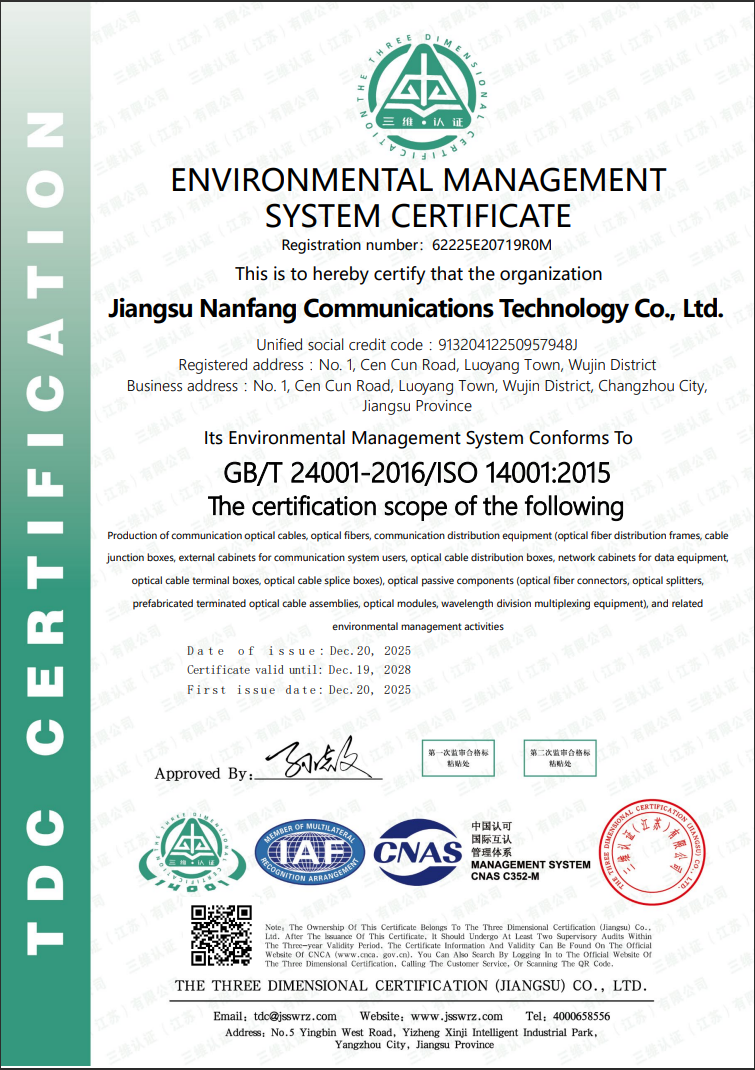
ISO 14001 certificate 62225E20719R0M, issued by SWR Certification (Jiangsu) Co., Ltd., valid to 19 December 2028.
ISO 14001 certificate 62225E20719R0M. Issued by SWR Certification (Jiangsu) Co., Ltd. against ISO 14001:2015, effective 20 December 2025 and valid to 19 December 2028. The certified scope covers production of communication optical cables, optical fibers and communication distribution equipment, including ODF units, cross connection cabinets, outdoor cabinets for communication systems, fibre distribution boxes, network cabinets for data equipment and fibre termination. For a buyer, this is the environmental-management evidence that typically appears in public tender documentation.
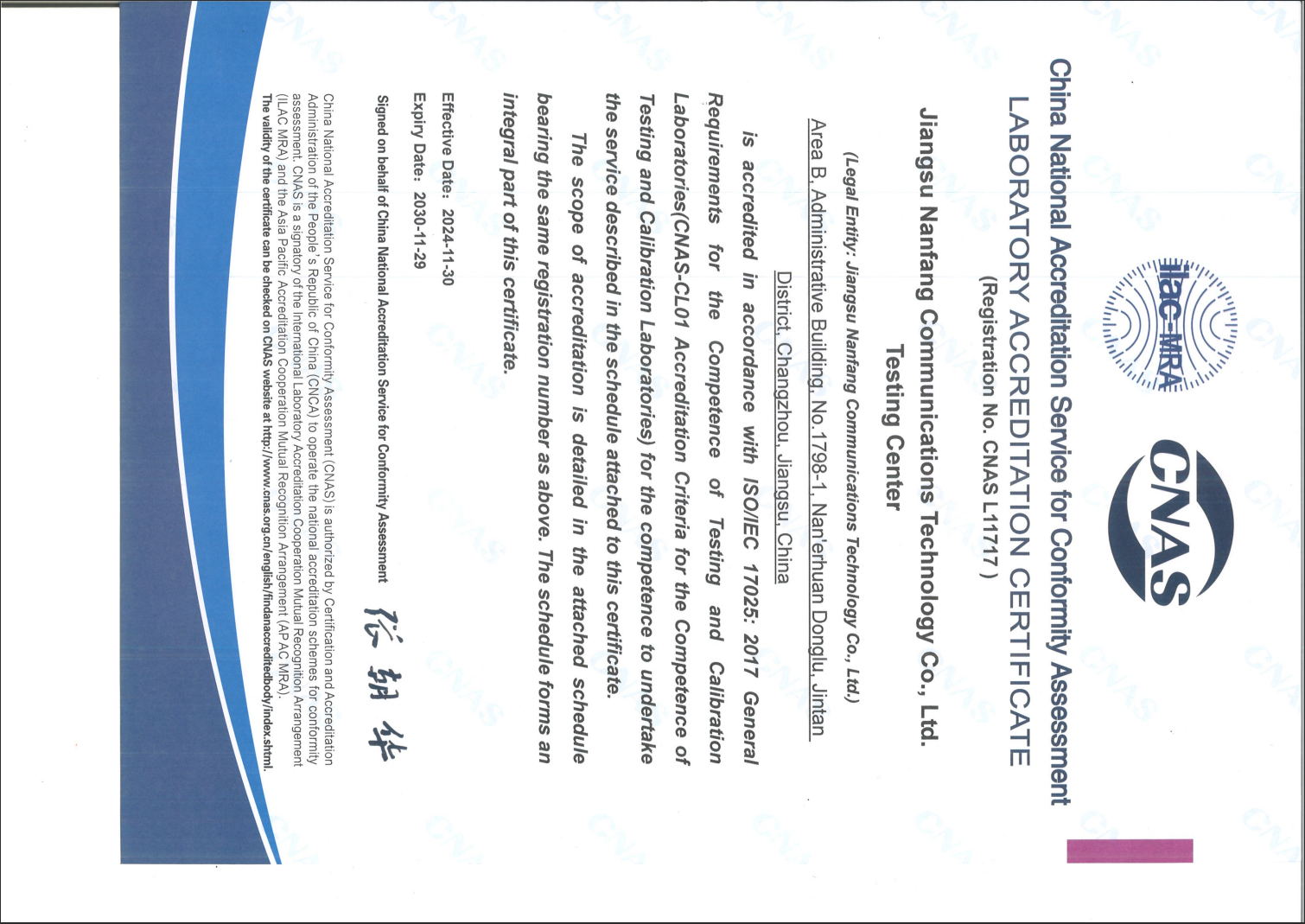
CNAS laboratory accreditation L11717, issued under ISO/IEC 17025:2017 for optical fiber cable and optical communication component testing and calibration.
CNAS laboratory accreditation L11717. Accredited by the China National Accreditation Service for Conformity Assessment against ISO/IEC 17025:2017, effective 30 November 2024 and valid to 29 November 2030. The accredited scope covers testing and calibration of optical fiber cable and optical communication components — which is where insertion-loss and return-loss measurements on MPO adapters are performed. An accredited in-house laboratory reduces the risk that a datasheet figure cannot be reproduced on receipt.
At company level, quality management is additionally covered by ISO 9001 and TL9000-H (certificate 15/25T15218R11, valid to 19 October 2028), and occupational health and safety by ISO 45001 (certificate 62225S20720R0M, valid to 19 December 2029). Jiangsu South Communication Technology Co., Ltd., trading as Nanfang Communication, operates from Changzhou City, Jiangsu Province, and has been manufacturing fibre and cable products since 1992. Its stated output capacity is 3,000,000 core kilometres per year, supported by 80 R&D engineers and a 26,795.3 m² facility.
FAQ
1. Which certifications support the MPO-12F-SM adapter supply, and what do they cover?
Three layers of evidence are documented. Environmentally, ISO 14001 certificate 62225E20719R0M covers production of communication optical cables, optical fibers and communication distribution equipment, and is valid to 19 December 2028. On quality, the manufacturing operation holds ISO 9001 and TL9000-H (certificate 15/25T15218R11, valid to 19 October 2028). On testing, the company holds CNAS laboratory accreditation L11717 under ISO/IEC 17025:2017, scoped to optical fiber cable and optical communication component testing and calibration — the discipline in which insertion loss and return loss are measured.
2. Can a single adapter family cover both the standard and low-loss requirement?
Yes. The MPO-12F-SM adapter is offered in two insertion-loss grades: standard at <0.5 dB and low-loss at <0.35 dB. Both grades share a single-mode return loss of ≥50 dB, a mating-cycle rating of 500 cycles compliant with IEC requirements, an operating temperature range of −40°C to +85°C, and a fibre count range of 4–72F in single-mode and multimode. Construction is identical across grades: ceramic ferrule, plastic housing and metal flange.
3. How should the cost question be framed when choosing between the grades?
Frame it as a link-budget question rather than a component-price question. The measurable difference between the grades is 0.15 dB per interface; across a channel containing four MPO interfaces, that is up to 0.6 dB of recovered margin. Where that recovered margin avoids a change of transceiver class or a re-design of the route, the low-loss grade pays for itself. Where margin is already comfortable, the standard grade is the appropriate specification. Pricing itself depends on model and order quantity and should be confirmed directly with the supplier.
4. Can I validate a specific grade before committing to volume?
Sample and small-volume validation is part of the standard commercial process. The company states a minimum order quantity of 1 core kilometre at company level, and notes that sample and small orders typically take several weeks while large orders may take months. Because insertion loss and return loss are measurable on received goods, sample validation should include an optical loss test against the datasheet limits rather than a visual inspection alone.
5. What is the lead time, and how should it be planned?
The company does not publish a single standard lead time. Stated guidance is that lead time depends on model and quantity, with samples and small orders typically taking several weeks and larger orders potentially taking months. For project scheduling, confirm lead time with sales at the point of order rather than assuming a fixed window. To start a specification review, you can request a quotation or sample through Nanfang Communication.
Conclusion
The standard versus low-loss MPO adapter decision is narrower than it first appears. Both grades of the MPO-12F-SM share the same construction, the same ≥50 dB single-mode return loss, the same 500-cycle IEC-compliant mating rating, the same −40°C to +85°C window and the same 4–72F fibre count range. Only insertion loss separates them: <0.5 dB versus <0.35 dB.
That single difference is worth acting on in exactly one situation — when a channel's calculated passive loss, multiplied across every interface in the path, approaches the transceiver's remaining budget. In that case, low-loss adapters are the lowest-effort way to recover margin. In every other case, standard grade is the correct specification, and the engineering attention belongs on mating-cycle planning and on verifying that the supplier can actually measure what it claims.
Both of those verification requirements are answerable with documents: ISO 14001 certificate 62225E20719R0M for environmental scope, TL9000-H and ISO 9001 for quality management, and CNAS laboratory accreditation L11717 under ISO/IEC 17025:2017 for the optical testing discipline itself.
Next Step: Review the Specification Against Your Link Budget
Nanfang Communication manufactures the MPO-12F-SM MPO Fiber Optic Adapter alongside optical fiber cable, MPO high-density patch panels, MTP/MPO fan-out pre-terminated cables and MPO/MTP loopbacks, with in-house testing under CNAS accreditation L11717.
Request a sample or quotation, or download the MPO product catalogue: MPO Product Catalogue (PDF)

Nanfang Communication has manufactured fibre and cable products since 1992, with a stated annual output capacity of 3,000,000 core kilometres.
Have Questions or Need More Details?
Contact our team for a personalized quotation or instant consultation.
Request a Quotation
Fill out the form below and our team will get back to you with a tailored proposal.
WhatsApp Direct Chat
Prefer to chat in real-time? Message us on WhatsApp for instant assistance & quick answers.
- Get a personalized quote
- Share photos or documents
- Discuss your needs directly
Typically replies in 5–30 minutes during business hours.