
Top 5 Pre-Terminated MTP/MPO Solutions for 40G/100G/400G Networks
Top 5 Pre-Terminated MTP/MPO Solutions for 40G/100G/400G Networks
For most 40G, 100G and 400G cabinet-interconnection projects, the highest-value pre-terminated MTP/MPO solution is a 12-fiber low-loss fan-out breakout cord: it removes field termination, maps directly to SR4/PSM4 module ports and leaves the widest insertion-loss headroom. The four solutions ranked below it complete the same link — higher fiber counts, panel-side coupling, structured patching and commissioning. This ranking is written for network architects and data center project engineers at the research-to-evaluation stage, and it is scored on five criteria: insertion-loss headroom, fiber-count mapping, rack density, coverage of the build, patch and test stages, and available fiber and jacket options.
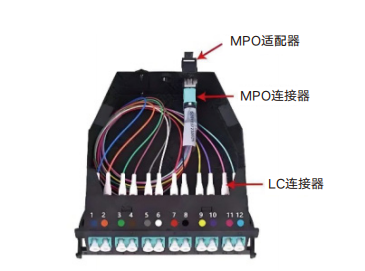
Problem Definition: Parallel Optics Broke the Duplex Patching Model
In a duplex-only patch field, one LC connector equals one channel and one polarity decision. Parallel optics changed that unit of cabling. 40G, 100G and 400G SR4/PSM4 module ports are delivered on multi-fiber connector interfaces, so a single connector position now carries a group of transmit and receive lanes.
Every MPO/MTP interface in that path is a termination point, and each field-terminated interface introduces three project risks: insertion loss that cannot be predicted accurately before test, contamination or end-face damage during handling, and a schedule that depends on craft skill rather than on the installation plan. Pre-terminated assemblies move those terminations into the factory, where the fiber, ferrule and polish are completed and tested before shipment — the field task becomes routing, mating and verification.
The remaining question for a buyer is not whether to pre-terminate, but which pre-terminated solution belongs at each point of the channel. Four constraints usually decide it:
- Link budget. The sum of connector, adapter and cable loss must stay below the optical margin the SR4/PSM4 modules require, including an allowance for re-mating and cleaning.
- Fiber-count mapping. The assembly fiber count and breakout must match the module port grouping, or lanes end up unused or mis-paired.
- Density. Connector positions and cable volume per rack unit determine how much patching the cabinet can absorb.
- Environment and schedule. Jacket rating, fiber type and the time available for turn-up decide which grade and construction can actually be installed and accepted.
Industry Background: Why the MPO Layer Is Growing Faster Than the Rest
Demand for this product family is being pulled by AI compute clusters and hyperscale data centers: the MPO fiber optic connector market is projected to grow at a CAGR of 13.6% through 2035 (Business Research Insights). The wider connector market remains anchored by single-fiber interfaces — the global fiber optic connector market was estimated at USD 11.2 billion in 2024, with LC connectors holding a 35.43% share (Global Market Insights / Grand View Research) — which is exactly why fan-out assemblies that convert a multi-fiber MPO end into LC duplex channels stay central to 40G/100G/400G builds. The two interfaces grow together, not at each other's expense.
Market-size figures for the underlying cable layer should be read with caution, because research firms disagree. Published 2025 estimates for the global optical fiber cable market range from USD 10.8 billion (Grand View Research) to USD 13.45 billion (Custom Market Insights) to USD 14.6 billion (Global Market Insights); Custom Market Insights projects USD 36.48 billion by 2034. Supply is also concentrated — Corning Incorporated led the global fiber optic cable market in 2025 with a share above 21.5% (Global Market Insights) — while China exports of optical fiber cables under HS 854470 reached approximately USD 2.52 billion in 2024 (OEC).
Two ITU standards frame the single-mode side of these projects: ITU-T G.652.D remains the industry standard for single-mode fiber, and G.657 is the primary standard for bend-insensitive fiber used in FTTH (ITU). In practice that produces a two-part fiber menu for high-density work: OM3, OM4 or OM5 multimode where 40G/100G/400G SR4/PSM4 modules are used, and OS2/G.657A single-mode where the reach requirement or the future upgrade path demands it.
How These Five Solutions Were Ranked
This is a procurement shortlist for cabinet and panel deployments, not a claim that one product is universally superior. Each position reflects five criteria:
- Insertion-loss headroom — typical and maximum insertion loss measured against the SR4/PSM4 link budget.
- Fiber-count mapping — how directly the fiber count and breakout match module port groups.
- Density — channels per rack unit and connector positions per panel.
- Stage coverage — whether the part serves the build stage, the reconfiguration stage or the test stage.
- Material and jacket options — available fiber types, jacket ratings and ferrule construction.
All five solutions are manufactured by Nanfang Communication, the brand of Jiangsu South Communication Technology Co., Ltd. (Changzhou, Jiangsu Province, China), and the parameters quoted below come from the company published product data. Buyers should still validate each assembly against their own end-to-end loss budget and cabling plan before freezing a bill of materials.
The Top 5 Pre-Terminated MTP/MPO Solutions for 40G/100G/400G Networks
#1 — MTP-12F-to-6xLC-Duplex Fan-out Pre-terminated Cable
The 12-fiber fan-out ranks first because it performs the most common job in a 40G/100G/400G cabinet with the fewest compromises. The assembly terminates 12 fibers in an MTP/MPO connector at one end and breaks them out to six LC duplex channels at the other. Nanfang Communication lists its target applications as data center cabinet interconnection and 40G/100G/400G SR4/PSM4 module connection.
Published parameters: insertion loss 0.35 dB typical and 0.75 dB maximum in the standard grade, or 0.10 dB typical and 0.35 dB maximum in the low-loss grade; return loss ≥60 dB with APC and ≥50 dB with PC; fiber count 12F; breakout available as LC/SC duplex or quad across the family; jacket in LSZH or OFNR; construction built on OM3/OM4/OM5 or OS2/G.657A fiber with a ceramic ferrule.
For a loss calculation, the grade matters more than the headline number. At 0.10 dB typical insertion loss, a low-loss fan-out cord consumes a small fraction of the optical margin that parallel-optics links must reserve for aging, re-mating and cleaning, whereas the standard grade at 0.35 dB typical still fits most cabinet-level runs. The limitation is granularity: one cord serves one 12-fiber group, and polarity plus breakout length must be confirmed before ordering.
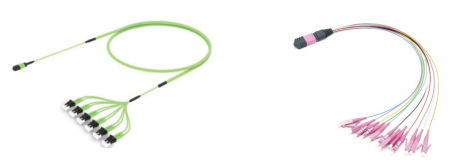
#2 — MTP-24F-to-12xLC-Duplex Fan-out Pre-terminated Cable
This solution doubles the fiber count of the first entry in the same optical class: 24 fibers in the MPO end broken out to twelve LC duplex channels, with identical insertion-loss and return-loss ratings, the same OM3/OM4/OM5 or OS2/G.657A fiber options and the same ceramic ferrule construction.
It ranks second rather than first because density only pays when the panel and module plan can use 24 fibers in one connector position. In a mixed environment, standardizing on 12F reduces spares complexity and simplifies polarity bookkeeping; in a dense cabinet where patch positions are scarce, the 24F assembly halves the number of connector positions to manage and keeps trunk-to-cabinet routing cleaner.
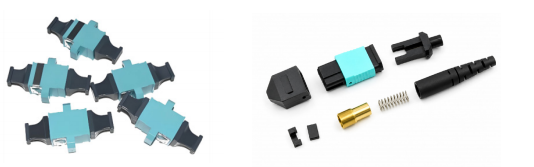
#3 — MPO-12F-SM Fiber Optic Adapter
Panel-side coupling decides whether a patch field can be reconfigured without touching cable terminations, and this is the component that makes pre-terminated cabling operational rather than permanent. The Nanfang Communication MPO-12F-SM adapter is rated at below 0.5 dB insertion loss in standard grade and below 0.35 dB in low-loss grade, with ≥50 dB return loss in single-mode, 500 mating cycles compliant with IEC, an operating temperature range of −40 °C to +85 °C, and support for 4–72 fiber single-mode and multimode configurations. Housing colors are black (flange with ears), aqua for OM3 and violet for OM4, giving installers a visual fiber-type check at the panel.
It ranks third because an adapter is a coupler, not a transmission path: it adds its own insertion loss and its own cleaning requirement to every channel it serves. The upside is that a worn or contaminated adapter can be replaced without cutting or re-terminating the trunk, which is why adapter loss should be budgeted as a separate line in the project loss worksheet.
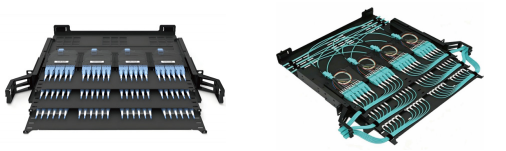
#4 — MPO High-density Patch Panel with Pre-terminated Trunk Cabling
Between the cabinet breakout cords and the row or distribution-area backbone sits a structured layer: pre-terminated multi-fiber trunk assemblies terminated at an MPO high-density patch panel. This layer ranks fourth because it is a scale-out decision rather than a per-link one — it changes how a project grows, not how a single channel performs.
The practical value is reconfiguration without re-termination. Trunk cabling stays fixed in the tray while moves, adds and changes are executed with pre-terminated cords at the panel. Port density and panel dimensions are configuration-dependent, so panel parameters should be confirmed model by model against the datasheet before the rack elevation is frozen. Two rules keep this layer predictable: match the panel fiber count and polarity to the trunk assembly, and hold adapter loss (entry #3) inside the same loss worksheet as the cords.
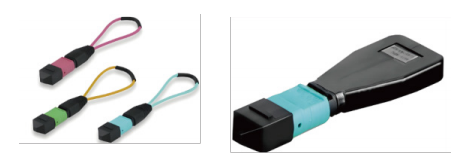
#5 — MPO/MTP Loopback (MPO-12F-Loopback / MPO-24F-Loopback)
A pre-terminated program is only as good as its acceptance test, and parallel-optics links cannot be fully validated with duplex-only test accessories. The MPO/MTP loopback returns a transmitter to its receiver inside the same multi-fiber interface, which allows a port to be proven before the far end is built. Nanfang Communication offers 12F and 24F models for network testing, data center commissioning and equipment validation.
Published parameters: low-loss insertion loss ≤0.7 dB for 8F/12F and ≤1.0 dB for 24F; return loss ≥65 dB in single-mode and ≥25 dB in multimode; fiber types OS2/OM1/OM2/OM3/OM4/OM5; ≥100,000 mating cycles; link failure rate below 0.1%. It ranks fifth because it carries no production traffic — but it is frequently the item that decides whether a turn-up window closes on schedule.
Supplier Context: Who Manufactures These Five Solutions
All five items are produced by Nanfang Communication, the brand of Jiangsu South Communication Technology Co., Ltd., a subsidiary of the Hong Kong-listed South Communication Holdings Limited (Stock Code: 1617.HK). The company was founded in July 1992 and operates from Changzhou, Jiangsu Province, China, with a 26,795.3 m² facility, 360 employees, 80 R&D engineers and a stated annual output of 3,000,000 core kilometers (monthly capacity 250,000 core kilometers). Its portfolio covers optical fibers, optical cables, ODN systems and optical components — indoor and outdoor optical cables, PLC splitters, fiber optic connectors, MPO multi-core connectors, optical modules and MT-FA series passive components — plus custom specialty fibers and system integration.
Certifications include ISO9001, TL9000, ISO14001, OHSAS18001, ISO50001 and the Integration of Informatization and Industrialization Management System, alongside a CNAS-accredited laboratory. The company holds more than 300 patents (over 45 invention patents) and has contributed to 16 standards (1 national standard, 15 industry standards). Its stated main market is China, with export markets in China Hong Kong and Southeast Asia; reference customers include China Telecom, China Mobile, China Unicom and China Broadcast Network, plus private-network users in high-speed rail, power grids and chemical industries. For buyers sourcing pre-terminated MPO assemblies, the practical takeaway is to confirm regional supply coverage and lead time against your own project schedule rather than assuming a local stock position.
Step-by-Step Breakdown: Specifying a Pre-Terminated MTP/MPO Channel
- Fix the channel plan. Count the SR4/PSM4 module ports per cabinet and decide the fiber grouping — 12F or 24F — before any part number is issued. This single decision determines entries #1, #2 and #4.
- Set the loss worksheet. List every element: breakout cord, adapter, trunk, panel. Compare the total against the module optical margin rather than against a single component maximum, and choose the standard or low-loss grade accordingly (0.75 dB max versus 0.35 dB max on the 12F/24F family).
- Choose fiber type and jacket. OM3/OM4/OM5 or OS2/G.657A, with LSZH or OFNR jacketing for in-cabinet assemblies. For cable runs, confirm attenuation (dB/km), operating wavelength, minimum bend radius, tensile strength, sheath material and environment rating per the model datasheet.
- Plan the panel side. Select MPO adapters (#3) and the patch panel layout so that moves and adds can be executed without touching trunk terminations, and keep adapter quantity and loss in the same worksheet.
- Check installation conditions. Indoor cabling, duct or ducting, aerial/self-supporting and direct-burial installations, plus outdoor harsh environments, carry different requirements — weatherproofing, waterproofing, rodent protection and temperature resistance all affect construction choice.
- Install and route. Respect the specified minimum bend radius, avoid tension on the breakout legs, and keep polarity consistent from trunk to panel to module.
- Test and record. Use the loopback (#5) for port-level verification and record insertion loss and return loss per channel. Its ≥100,000 mating cycle rating and link failure rate below 0.1% make it suitable as a repeat-use commissioning tool.
- Label and document. Core count, labeling and packaging are configurable, so agree the labeling standard before production rather than at the rack.
Use Cases: Where Each Solution Fits
Data center cabinet interconnection
The most common deployment: 12F or 24F fan-out cords connect SR4/PSM4 module ports to panel-side LC duplex patching inside the same cabinet or between adjacent cabinets. Choose the 12F version for standard port groups and the 24F version where cable volume and connector positions are the binding constraint.
High-density patching in telecom networks
Telecom and high-density cabling systems use MPO adapters and patch panels to consolidate multi-fiber interfaces, allowing capacity to be added at the panel instead of at the cable. Adapter color coding (aqua for OM3, violet for OM4, black for the flanged single-mode housing) supports fiber-type segregation in mixed patching areas.
Commissioning and equipment validation
Before traffic is handed over, loopbacks verify transmitter and receiver pairs, cabling polarity and module operation. The same accessory supports lab validation of new line cards and troubleshooting of suspected link failures.
Adjacent segments served by the same portfolio
Projects that combine a data center build with access or transport work can source the non-MPO portion from the same supplier: FTTH/FTTx access projects, metropolitan and backbone network projects, operator network expansion, 5G backhaul, and enterprise or campus network deployments all use optical cable with special requirements such as low attenuation, low insertion loss, flame-retardant or LSZH sheaths, waterproof sealing, crush and tensile resistance, corrosion and weather resistance, and customizable core counts and labeling.
Comparison Table: Five Pre-Terminated MTP/MPO Solutions
Only published parameters are listed. Where a value is not published for a specific configuration, confirm it against the model datasheet.
| Rank | Solution and model | Insertion loss | Return loss | Fiber count and breakout | Primary scenario |
|---|---|---|---|---|---|
| #1 | MTP/MPO fan-out pre-terminated cable — MTP-12F-to-6xLC-Duplex | 0.35 dB typical / 0.75 dB max (standard); 0.10 dB typical / 0.35 dB max (low-loss) | ≥60 dB (APC); ≥50 dB (PC) | 12F; 6x LC duplex (family also offers LC/SC duplex or quad) | Data center cabinet interconnection; 40G/100G/400G SR4/PSM4 module connection |
| #2 | MTP/MPO fan-out pre-terminated cable — MTP-24F-to-12xLC-Duplex | Same rating class as #1 | ≥60 dB (APC); ≥50 dB (PC) | 24F; 12x LC duplex | High-density cabinet interconnection where panel positions are limited |
| #3 | MPO fiber optic adapter — MPO-12F-SM | Below 0.5 dB standard; below 0.35 dB low-loss | ≥50 dB (SM) | 4–72F SM/MM | Panel-side coupling in data centers, telecom networks and high-density cabling systems |
| #4 | MPO high-density patch panel with pre-terminated trunk cabling | Configuration-dependent — confirm per datasheet | Configuration-dependent — confirm per datasheet | Defined by panel and trunk configuration | Structured patching layer; moves, adds and changes without re-termination |
| #5 | MPO/MTP loopback — MPO-12F-Loopback / MPO-24F-Loopback | ≤0.7 dB low-loss (8F/12F); ≤1.0 dB (24F) | ≥65 dB (SM); ≥25 dB (MM) | 8F/12F and 24F; OS2/OM1/OM2/OM3/OM4/OM5 | Network testing, data center commissioning, equipment validation |
Additional data for specification work: the fan-out family uses OM3/OM4/OM5 or OS2/G.657A fiber with ceramic ferrules and PVC or LSZH jackets rated LSZH/OFNR; the loopback family uses a ceramic/MTP ferrule, plastic housing and fiber cable; the adapter uses a ceramic ferrule, plastic housing and metal flange; and the adapter IEC-compliant mating rating is 500 cycles against ≥100,000 cycles for the loopback. Mating-cycle ratings are not interchangeable in procurement documents — they describe different components with different replacement cycles.
FAQ: Pre-Terminated MTP/MPO Cabling for 40G/100G/400G
What insertion loss should a pre-terminated MPO assembly meet for 40G/100G/400G links?
There is no single universal number, because the acceptable loss depends on the total link budget. As a reference point, the Nanfang Communication 12F/24F fan-out family is published at 0.35 dB typical and 0.75 dB maximum insertion loss in the standard grade, and 0.10 dB typical and 0.35 dB maximum in the low-loss grade, with return loss ≥60 dB (APC) and ≥50 dB (PC). The MPO-12F-SM adapter is rated below 0.5 dB in standard grade and below 0.35 dB in low-loss grade. On the single-mode side, ITU-T G.652.D remains the industry standard for single-mode fiber and G.657 is the primary standard for bend-insensitive fiber used in FTTH (ITU), so the fiber selection should be stated explicitly in the specification rather than left to the supplier.
Can fan-out cables, adapters and panels be customized for a specific project?
Yes. Nanfang Communication production mode covers manufacturing, R and D and testing, engineering design, system integration and ODM/OEM services, and the customizable items listed are core count, fiber type (single-mode, multimode, ribbon or multi-core), sheath material and color, connector types and cabling schemes, labeling and packaging. That range covers the practical variables in a pre-terminated program: fiber count per assembly, breakout configuration, jacket rating and panel labeling. Customization should be confirmed per model and per project, because published parameters apply to standard configurations.
What is the minimum order quantity, and what drives cost?
The published minimum order quantity is 1 core kilometer. Cost in this product family is driven mainly by configuration choices rather than by a fixed list price: fiber type (OM3/OM4/OM5 versus OS2/G.657A), loss grade (standard versus low-loss), fiber count (12F versus 24F), jacket material and rating, connector types, and labeling or packaging requirements. Because these variables change the assembly, pricing and lead time are quoted per configuration — request a quote with the fiber count, loss grade, connector types and quantity stated.
How should a pre-terminated MPO link be validated before acceptance?
Use a loopback rated for the interface being tested. The MPO-12F-Loopback and MPO-24F-Loopback are published for network testing, data center commissioning and equipment validation, with low-loss insertion loss ≤0.7 dB for 8F/12F and ≤1.0 dB for 24F, return loss ≥65 dB (SM) and ≥25 dB (MM), ≥100,000 mating cycles and a link failure rate below 0.1%. Factory quality control on the cable side includes incoming material inspection, in-process control and finished-product testing — optical loss and attenuation tests, mechanical performance tests and waterproof/sealing tests — supported by a CNAS-accredited laboratory. Ask for test records per assembly rather than a general certificate.
What lead time should be planned, and how do you start an order?
Lead time depends on model and quantity: samples and small orders typically take several weeks, while large orders may take months, so the schedule should be confirmed with sales before the deployment window is fixed. After-sales support includes technical support, a service network and engineering support, and the company operates 28 provincial-level offices in China for localized sales, technical support and after-sales service. To start, send the configuration (fiber count, loss grade, connector types, jacket, quantity) and your project timeline to info@jsnfgroup.com or call +86 51988792646; WhatsApp is available at +8619850287785. A sample can be requested through the same channels, and the MPO brochure linked below lists the portfolio in one document.
Conclusion: Choose by Loss Budget, Not by Connector Count
Ranking pre-terminated MTP/MPO solutions for 40G/100G/400G networks comes down to a repeatable decision: map the module ports, set the loss worksheet, and then pick the assembly that satisfies the worksheet at the lowest complexity. For most cabinet interconnection work that is the 12F low-loss fan-out cord; the 24F version takes over when connector positions and cable volume are constrained; adapters and high-density panels make the patch field reconfigurable; and loopbacks make the result testable.
Before committing a bill of materials, verify three things against your own design: the fiber grouping (12F versus 24F), the loss grade required for the module optical margin, and the labeling and polarity convention used across trunk, panel and cabinet. Those three decisions account for most of the difference between a first-pass acceptance and a re-worked patch field.

Next step
Nanfang Communication (Jiangsu South Communication Technology Co., Ltd.) manufactures the fan-out cables, MPO adapters, high-density patch panels and loopbacks described above. For project-specific samples, quotes or configuration support, contact info@jsnfgroup.com or visit www.jsnfgroup.com.
Download the MPO product brochure: Nanfang MPO Brochure (PDF).
Have Questions or Need More Details?
Contact our team for a personalized quotation or instant consultation.
Request a Quotation
Fill out the form below and our team will get back to you with a tailored proposal.
WhatsApp Direct Chat
Prefer to chat in real-time? Message us on WhatsApp for instant assistance & quick answers.
- Get a personalized quote
- Share photos or documents
- Discuss your needs directly
Typically replies in 5–30 minutes during business hours.