Optical Fiber Cable Datasheet, Decoded: Parameters & Certifications Buyers Should Check
Optical Fiber Cable Datasheet, Decoded: Parameters & Certifications Buyers Should Check
The gap between a datasheet and a dependable network is filled with details that buyers often discover too late. This guide decodes the optical fiber cable datasheet — fiber type, attenuation, mechanical limits, MPO component performance, and certification evidence — and turns it into a verification checklist for the Research and Evaluation stages of procurement.
Optical fiber cable selection looks straightforward on the surface: choose a fiber type, a core count, and a length. In practice, every deployment — FTTH, data center, 5G backhaul, campus network — imposes its own constraints on attenuation, bend radius, mechanical strength, sheath material, and connector performance. When those constraints are not verified before ordering, the cost of correction lands on the project.
This article uses the product and manufacturing data of Jiangsu South Communication Technology Co., Ltd. (brand name: Nanfang Communication) as a worked example. Nanfang Communication, founded in July 1992 and located in Changzhou, Jiangsu Province, China, is a subsidiary of the Hong Kong-listed South Communication Holdings Limited (Stock Code: 1617.HK). The company researches, develops, produces and sells communication optical cables, optical fibers, ODN products, MPO optical connectors, MT-FA series optical passive components, and related communication equipment.
After reading this guide, you should be able to ask suppliers precise questions about fiber type, attenuation, mechanical limits, MPO component losses, and certificate validity — and to compare quotations on the same technical basis.
Why Unverified Specifications Create Project Risk
Procurement problems rarely announce themselves at the contract stage. They emerge during installation or operation. A cable ordered without checking its minimum bend radius may pass the acceptance test but fail during routing. An indoor cable installed outdoors can suffer sheath degradation from UV and moisture. An MPO adapter with borderline insertion loss can push a 12-fiber trunk over its link budget.
Buyers moving from Research to Evaluation need to shift their focus from which supplier is well known to which product meets the constraints of my deployment. For optical fiber cable, those constraints fall into three groups:
- Technical parameters — fiber type, core count, attenuation, operating wavelength, mechanical and environmental ratings.
- Component performance — insertion loss, return loss, mating cycles, and operating temperature of connectors and pre-terminated assemblies.
- Certification evidence — certificates that verify both the management system and the testing capability behind the product.
Without a disciplined verification process, price becomes the only differentiator — and mis-specification becomes the likely result.
Market Context: Growth, Standards, and the Case for Verification
The scale of the optical fiber cable market explains why buyers face such a wide range of suppliers. According to Custom Market Insights, the global optical fiber cable market was valued at approximately USD 13.45 billion in 2025 and is projected to reach USD 36.48 billion by 2034. China's exports of optical fiber cables reached approximately USD 2.52 billion in 2024, according to the Observatory of Economic Complexity (OEC).
The component market is equally substantial. Global Market Insights estimates the global fiber optic connector market at USD 11.2 billion in 2024, with LC connectors holding a dominant 35.43% share. High-density connectivity is growing faster than the broader market: Business Research Insights projects the MPO fiber optic connector market to grow at a compound annual growth rate (CAGR) of 13.6% through 2035, driven by AI compute clusters and hyperscale data centers.
Standards provide the common language for comparison. ITU-T G.652.D remains the industry standard for single-mode fiber, while ITU-T G.657 is the primary standard for bend-insensitive fibers used in FTTH. Buyers should expect every optical fiber cable datasheet to state which fiber standard the cable follows.
The market also remains competitive. One global manufacturer held a market share above 21.5% in 2025, according to Global Market Insights, which means the majority of supply comes from a long tail of manufacturers whose credentials must be verified individually rather than assumed.
Optical Fiber Cable Parameters: Reading the Datasheet Line by Line
Every optical fiber cable manufacturer publishes a datasheet, but the useful information is in how completely that datasheet answers the following questions.
Fiber Type: G.652, G.657, Single-Mode, and Multimode
Common single-mode fiber types include G.652 and G.657. Multimode fibers are specified by category such as OM1, OM2, OM3, OM4, and OM5. Single-mode fiber is typically used in telecom and longer-distance links; multimode fiber is commonly used in shorter data-center links. Ribbon fiber and multi-core fiber (MCF) serve specialized high-density or high-capacity applications. The fiber type determines which transceivers and wavelengths the link can support, so it must be locked before any other parameter is negotiated.
Core Count and Core Diameter
Core count and core diameter are specified per model. A 12-fiber cable and a high-fiber-count ribbon cable serve completely different purposes. The core count should match the projected demand of the link, including future expansion.
Attenuation and Operating Wavelength
Typical attenuation values for optical fiber cable are specified in dB/km. Lower attenuation supports longer unrepeatered spans and simplifies link-budget planning. Operating wavelengths are within typical optical communication bands, including the 1310 nm and 1550 nm windows commonly used for single-mode transmission. The datasheet should state both the wavelength and the attenuation at that wavelength.
Mechanical Limits: Tensile Strength and Minimum Bend Radius
Tensile strength ratings and minimum bend radius are provided in the datasheet. These values determine how the cable can be pulled and routed during installation. A cable with a tight minimum bend radius is easier to route in confined indoor spaces; a cable with high tensile strength is better suited to long outdoor pulls.
Sheath, Armoring, and Strength Members
Sheath material options include PE and LSZH. PE is commonly used for outdoor jackets; LSZH is preferred indoors where low smoke and low flame emission are required. Armoring materials include galvanized steel wire and galvanized steel tape, which add crush resistance and rodent protection for outdoor or direct-burial routes. Strength members are made of FRP and other materials; FRP provides tensile support while keeping the cable non-metallic. The core material is silica glass, the standard transmission medium for optical fiber.
Matching Cable Construction to Deployment Scenario
Fiber type and cable construction should follow the deployment scenario, not the other way around.
| Cable type | Typical deployment role | What to check |
|---|---|---|
| Indoor optical cable | Building risers, equipment rooms, data center internal routing | LSZH sheath, bend radius, flame-retardant rating |
| Outdoor optical cable | Duct, aerial, or direct-burial routes between buildings or central offices | PE sheath, armoring, water-blocking, tensile strength |
| Bow-type drop optical cable | FTTH last-mile connection from distribution point to subscriber | Bend-insensitive fiber (e.g., G.657), field-termination compatibility |
| Ribbon optical cable | High-fiber-count backbone, data center, and access networks | Fiber count, ribbon structure, splice and termination method |
| Loose-tube optical cable | Outdoor trunk and backbone routes where fibers need isolation from strain | Water-blocking, tube fill, armoring, temperature range |
These categories are starting points, not rigid rules. A specific project may require a hybrid design, and manufacturers with engineering capabilities can adjust core count, sheath, and connector configuration. Nanfang Communication, for example, offers customization of core count, fiber type (single-mode, multimode, ribbon, multi-core), sheath material and color, connector types and cabling schemes, labeling, and packaging.
Component-Level Parameters: MPO Adapters, Fan-Out Cables, and Loopbacks
Pre-terminated MPO systems have become standard in high-density data centers. They shift the quality burden from field splicing to factory-terminated components. That makes component datasheets as important as the cable datasheet itself.
MPO Fiber Optic Adapter (MPO-12F-SM)
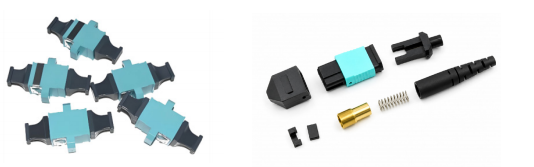
The MPO-12F-SM is a single-mode MPO adapter with low insertion loss. It is made of a ceramic ferrule, plastic housing, and metal flange. Its standard insertion loss is less than 0.5 dB; the low-loss version is less than 0.35 dB. Return loss for single-mode is at least 50 dB. Mating cycles are 500 cycles, compliant with IEC standards. The operating temperature range is -40°C to +85°C. The fiber count ranges from 4 to 72 fibers, supporting both single-mode and multimode. Available colors include black (flange with ears), aqua (OM3), and violet (OM4).
For a buyer, the important numbers are the insertion loss and mating cycles. In a high-density patching environment, an adapter that cannot maintain its loss after repeated plugging will degrade link performance over time.
MTP/MPO Fan-Out Pre-Terminated Cable / Breakout Patch Cord
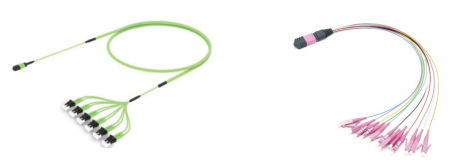
The MTP/MPO fan-out pre-terminated cable (also called breakout patch cord) is available in models such as MTP-12F-to-6xLC-Duplex and MTP-24F-to-12xLC-Duplex. Typical insertion loss is 0.35 dB, with a maximum of 0.75 dB. The low-loss version offers a typical insertion loss of 0.10 dB and a maximum of 0.35 dB. Return loss is at least 60 dB for APC and at least 50 dB for PC. Fiber counts are 12 or 24 fibers, with LC/SC duplex or quad breakouts. Jacket options include LSZH and OFNR. These cables are used for data center cabinet interconnection and 40G/100G/400G SR4/PSM4 module connections.
When evaluating a breakout cable, compare the maximum insertion loss, not just the typical value. Low-loss versions matter when the link budget is tight and multiple connections are placed in series.
MPO/MTP Loopback
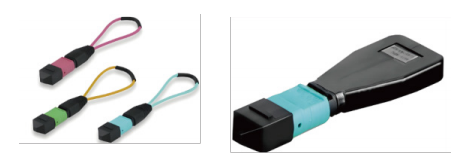
The MPO/MTP loopback is available as MPO-12F-Loopback and MPO-24F-Loopback. Low-loss insertion loss is ≤0.7 dB for 8-fiber and 12-fiber versions, and ≤1.0 dB for the 24-fiber version. Return loss is ≥65 dB for single-mode and ≥25 dB for multimode. Supported fiber types include OS2 and OM1 through OM5. Mating cycles are ≥100,000, and the link failure rate is less than 0.1%. It is used in network testing, data center commissioning, and equipment validation.
The loopback is a testing tool, so durability matters more than absolute low loss. The 100,000 mating cycles and failure rate below 0.1% are the parameters that keep test results consistent over the life of the device.
Certification Evidence: Documents Buyers Should Request
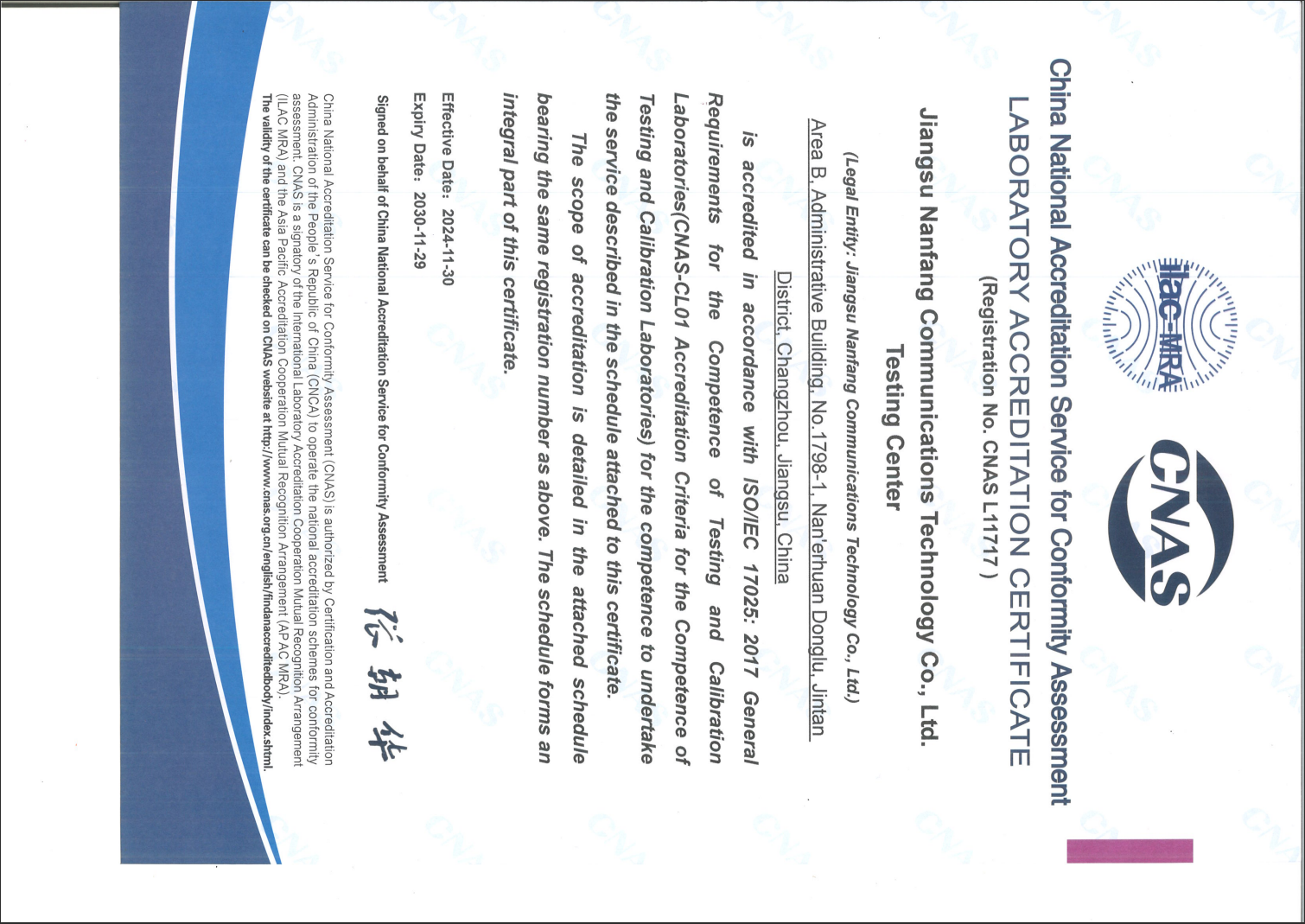
Certifications are not branding. They are audited evidence. A verified certificate has four elements: a certificate number, an issuing body, a defined scope, and a validity period. The table below shows the current certification portfolio of Nanfang Communication as a reference for the level of detail a buyer should request from any supplier.
| Certificate | Standard | Certificate No. | Issuing body | Valid through |
|---|---|---|---|---|
| CNAS Laboratory Accreditation | ISO/IEC 17025:2017 | CNAS L11717 | China National Accreditation Service for Conformity Assessment (CNAS) | 2030-11-29 |
| TL9000-H | TL9000 R6.3 / R5.7 / R5.9 | 15/25T15218R11 | WIT Assessment / Hangzhou WIT Assessment Co., Ltd. | 2028-10-19 |
| ISO 14001 | ISO 14001:2015 | 62225E20719R0M | SWR Certification (Jiangsu) Co., Ltd. | 2028-12-19 |
| ISO 45001 | ISO 45001:2018 | 62225S20720R0M | SWR Certification (Jiangsu) Co., Ltd. | 2028-12-19 |
Three points deserve attention.
First, CNAS L11717 is a laboratory accreditation, not a product certificate. It confirms that the laboratory is recognized, under ISO/IEC 17025:2017, for testing and calibration of optical fiber cable and optical communication components, in China and global markets. When a supplier quotes insertion loss below 0.35 dB or attenuation in dB/km, the credibility of that number depends on the test method and the test laboratory behind it.
Second, TL9000-H is a telecom-specific quality management system. Compared with generic ISO 9001, TL9000 adds reliability measurements and category-specific requirements for the communications industry. The TL9000-H certificate held by Nanfang Communication covers the manufacture and sales of communication optical fiber cable.
Third, ISO 14001 and ISO 45001 cover production processes. These environmental and occupational health and safety certifications apply to the production of communication optical cables, optical fibers, and communication distribution equipment. For buyers, they indicate that the manufacturer operates with documented environmental controls and worker safety programs.
Finally, check validity dates. The certificates above were valid as of August 2026. A buyer should always request the current certificate document from the supplier instead of accepting a screenshot from a marketing page.
A Five-Step Verification Workflow for Buyers
The following workflow is designed for the Evaluation stage, when a buyer is comparing two or more suppliers on the same technical basis.
- Define the deployment scenario. Identify whether the cable is for FTTH, data center, campus, industrial, or backbone use. This determines the cable construction family: indoor, outdoor, bow-type drop, ribbon, or loose-tube.
- Lock the fiber type and transmission parameters. Confirm single-mode (e.g., G.652 or G.657) or multimode, core count, core diameter, attenuation in dB/km, and operating wavelength.
- Check mechanical and environmental ratings. Verify minimum bend radius, tensile strength, sheath material (PE or LSZH), armoring (galvanized steel wire or steel tape), and strength members (FRP).
- Verify component performance. For MPO-based systems, compare insertion loss and return loss, mating cycles, operating temperature, and fiber count for adapters, fan-out cables, and loopbacks.
- Validate certificates and test capability. Request the current certificate for TL9000-H, ISO 14001, ISO 45001, and laboratory accreditation. Confirm the certificate number, issuing body, scope, and expiration date.
Use Cases: How Parameter Choices Differ by Project Type
FTTH / FTTx Broadband Access
FTTH projects typically favor bend-insensitive single-mode fiber such as G.657, bow-type drop optical cable for the last mile, and distribution hardware such as PLC optical splitters and FTTH distribution boxes. Attenuation at the operating wavelength and bend radius are the most critical cable parameters because drop cables are routed through tight corners in residential buildings.
Data Center Interconnects
Data centers use both multimode and single-mode fiber depending on distance and transceiver type. MPO-based trunk cables, fan-out cables, adapters, and patch panels are used to support 40G/100G/400G SR4/PSM4 connections. Insertion loss of MPO components is the determining factor in whether the link budget closes.
5G Backhaul and Metropolitan / Backbone Networks
Long-distance outdoor routes favor loose-tube or armored outdoor cables with high tensile strength and water-blocking protection. Supporting items include optical cable splice closures and WDM wavelength division multiplexers. Attenuation per kilometer and environmental resistance matter most in these deployments.
Enterprise Campus and Industrial / Smart City Projects
Campus networks often combine indoor and outdoor cable in one project. LSZH-sheathed indoor cable is used inside buildings; PE-sheathed outdoor cable or armored cable connects buildings. A supplier that can deliver both cable types from one source simplifies procurement and ensures consistent quality across the boundary.
Supplier Capability Checks Beyond the Datasheet
Parameters and certificates describe what a supplier can produce; capability data describes whether they can produce it at the scale, quality, and schedule the project needs.
- Production scale: Nanfang Communication reports an annual output of 3,000,000 core kilometers and a monthly capacity of 250,000 core kilometers, with 360 employees and a factory area of 26,795.3 m².
- R&D and engineering: The company employs 80 R&D engineers and offers manufacturing, R&D and testing, engineering design and system integration, and ODM/OEM services.
- Customization: Customizable items include core count, fiber type (single-mode, multimode, ribbon, multi-core), sheath material and color, connector types and cabling schemes, labeling, and packaging.
- Quality control: The production process includes incoming material inspection, in-process control, and finished-product testing covering optical loss and attenuation, mechanical performance, and waterproof or sealing performance, supported by laboratory testing capabilities.
- Order flexibility: The stated minimum order is 1 core kilometer.
- Market track record: The company has established cooperative relationships with operators such as China Telecom, China Mobile, China Unicom, and China Broadcast Network, as well as private network users in high-speed railway, power grid, and chemical industries. It operates 28 provincial-level offices across China for localized sales, technical support, and after-sales service.
For international buyers, note that Nanfang Communication's export activity is focused on China's Hong Kong and Southeast Asia regions.
FAQ
1. Which certifications should I check when evaluating an optical fiber cable manufacturer?
At a minimum, request current certificates for TL9000-H, ISO 14001, and ISO 45001, plus laboratory accreditation if the supplier operates its own test lab. For Nanfang Communication, the TL9000-H certificate (No. 15/25T15218R11) is issued by WIT Assessment / Hangzhou WIT Assessment Co., Ltd. and is valid through 2028-10-19. The ISO 14001:2015 certificate (No. 62225E20719R0M) and ISO 45001:2018 certificate (No. 62225S20720R0M) are issued by SWR Certification (Jiangsu) Co., Ltd. and are valid through 2028-12-19. The laboratory accreditation (CNAS L11717) is issued under ISO/IEC 17025:2017 for testing and calibration of optical fiber cable and optical communication components. The scope covered by these certificates includes production of communication optical cables, optical fibers, and communication distribution equipment.
2. What optical fiber cable parameters must be verified before ordering?
For every cable model, confirm fiber type (e.g., G.652 or G.657 single-mode; multimode where applicable), core count, core diameter, attenuation in dB/km, operating wavelength, minimum bend radius, tensile strength, sheath material (PE or LSZH), armoring (galvanized steel wire or steel tape), strength members (FRP and others), and core material (silica glass). These parameters should appear in the model datasheet. If any are missing, ask the supplier to provide them before evaluation.
3. Do fiber type and cable construction affect optical fiber cable pricing?
Yes. Fiber type, core count, sheath material, armoring, and connector configurations all influence cost. Because each project uses a different combination of parameters, manufacturers rarely publish standardized price lists. Buyers can reduce budget uncertainty by sending a complete specification table — fiber type, core count, distance, indoor or outdoor environment, and connector type — and requesting a quotation based on those constraints. Order quantity also matters; Nanfang Communication, for example, states a minimum order of 1 core kilometer.
4. Can I request a sample or small order before committing to a large volume?
In most cases, yes. Confirm the sample policy with the supplier before evaluation. For Nanfang Communication, the MOQ is 1 core kilometer, and typical lead time for samples or small orders is several weeks. Use the sample to verify the parameters on the datasheet, including attenuation, connector insertion loss, sheath quality, and the labeling and contents of the delivered cable.
5. What is a realistic lead time for optical fiber cable orders?
Lead time depends on model and quantity; there is no single standard. Samples and small orders typically take several weeks, while large orders may take months. Non-standard core counts, custom sheath colors, or special connector configurations may require additional production time. For project planning, request a written lead-time commitment from the supplier. To discuss your model, quantity, and schedule, contact Nanfang Communication at info@jsnfgroup.com or +86 519 88792646 (WhatsApp: +86 19850287785).
Conclusion: Turn Parameters into Procurement Decisions
A reliable optical fiber cable purchase is built on verified parameters, documented certificates, and a supplier whose manufacturing capabilities match the project's scale. The market is large, the standards are established, and the data you need is obtainable — provided you ask for it in the right format.
Start with the checklist in this article, compare offers on the same set of parameters, and treat certificates as evidence rather than decoration.

Next step: Download the Nanfang Communication MPO product brochure for detailed component data, or contact the team for a quotation: info@jsnfgroup.com · +86 519 88792646 · WhatsApp +86 19850287785.
Have Questions or Need More Details?
Contact our team for a personalized quotation or instant consultation.
Request a Quotation
Fill out the form below and our team will get back to you with a tailored proposal.
WhatsApp Direct Chat
Prefer to chat in real-time? Message us on WhatsApp for instant assistance & quick answers.
- Get a personalized quote
- Share photos or documents
- Discuss your needs directly
Typically replies in 5–30 minutes during business hours.