
GYTA53, MPO Breakouts & Loopbacks: 5G and Data Center Guide
GYTA53, MPO Breakouts & Loopbacks: 5G and Data Center Guide
A two-site program needs one answer before any purchase order is raised: which component proves what, and at which stage? GYTA53 outdoor armored optical fiber cable carries and protects the physical path between a 5G backhaul or metropolitan backbone site and the point of presence. MTP/MPO fan-out pre-terminated cables organize the last metres inside a data center cabinet for 40G, 100G and 400G SR4/PSM4 module connections. MPO/MTP loopbacks validate equipment, ports and modules during commissioning, before traffic is handed over.
Nanfang Communication (Jiangsu South Communication Technology Co., Ltd.) produces all three families: optical fiber cable including the GYTA53 model, MPO multi-core connectors and assemblies, and ODN systems. That is why this guide treats them as one procurement and acceptance path rather than three unrelated purchases — with the important caveat that each item is signed off by a different measurement.
All figures quoted below come from the supplied product data and published standards. Cable parameters such as attenuation, bend radius and tensile strength remain model- and datasheet-specific; confirm them against the exact datasheet before they enter a tender or a loss budget.
The problem: three deliverables, three different pass criteria
Backhaul routes and data center fit-outs are normally managed by separate teams on separate schedules, against separate acceptance documents. The components still meet in the same building. GYTA53 cable terminates at a point of presence, the MPO infrastructure begins inside the rack, and the loopback sits between them for the duration of commissioning.
Each item is accepted differently:
- GYTA53 cable is accepted on attenuation at the operating wavelengths, on splice and closure records, and on sealing and mechanical evidence appropriate to the installation environment.
- MTP/MPO fan-out pre-terminated cable is accepted on insertion loss and return loss against the channel budget, plus polarity and end-face condition.
- MPO/MTP loopback is accepted on whether it loops a port back correctly, with its own insertion loss known and recorded.
Three errors follow from blurring those criteria. The first is signing off an installed channel with a loopback reading: a loopback tests a port against itself, not the fibre path between two racks. The second is choosing a standard-loss breakout for a channel whose budget only closes on low-loss figures, then discovering the shortfall at commissioning. The third is quieter and more common — treating a management-system certificate as if it were a product test result. A TL9000 or ISO certificate says the factory runs a controlled process; it does not state the attenuation of a drum or the insertion loss of a finished assembly.
Industry background: one physical layer, several environments
Optical fiber cable serves as the physical-layer transmission and distribution infrastructure in FTTH/FTTx access projects, metropolitan and backbone networks, data center interconnects, operator network expansion and 5G backhaul, and enterprise or campus deployments. It operates continuously as a passive element or as the supporting channel for active equipment, which is why stable maintenance and periodic inspection belong in the project plan rather than in a warranty conversation.
The environments differ sharply within that single description. Installation conditions range from indoor cabling to duct and ducting, aerial and self-supporting spans, direct burial, and harsh outdoor situations requiring weatherproofing, waterproofing, rodent protection and temperature resistance. The requirements list follows the environment: low attenuation, low insertion loss, flame-retardant or LSZH sheaths, waterproof sealing, crush and tensile resistance, corrosion and weather resistance, customizable core counts and labeling.
Market and trade context is sometimes useful when a program is being justified internally. Global Market Insights valued the global fibre optic cable market at USD 14.6 billion in 2025, and trade data compiled by the Observatory of Economic Complexity from UN Comtrade records shows China as the leading exporter of optical fibres and cables in 2024, at USD 2.52 billion. Both are market-level figures from third-party sources; they say nothing about the performance of a specific cable model or assembly.
Standards segment the same way. ITU-T L.103 (08/2024) describes characteristics, construction and test methods for indoor optical fibre cables; IEC 60794-1-104:2024 defines test procedures for impact performance; IEC 60092-378:2024 addresses shipboard and offshore fixed installations. Those are published standards, not certificates held by a supplier, and a specification should name the method it wants rather than the word “tested”.
GYTA53 outdoor armored cable for 5G backhaul and metropolitan backbone
GYTA53 is the outdoor armored optical fiber cable model in this range, sitting alongside indoor cable, ribbon cable, loose-tube cable, bow-type drop cable, single-mode and multimode fibre, and MCF multi-core fibre. In the supplied material set, the cable uses silica glass fibre, PE or LSZH sheath options, galvanized steel wire or steel tape armoring, and FRP strength members.
The parameters that decide acceptance are: fibre type (for example G.652 or G.657), core count, core diameter, attenuation in dB/km, operating wavelengths, minimum bend radius, tensile strength, sheath material and environmental rating. These are the numbers a route design actually consumes, and they must be confirmed per model datasheet — a family description is not a substitute for the drum specification that will arrive on site.
The scenario fit is broad and is stated in the product data: telecommunications operators, ISPs and data centers, FTTx and broadband access, enterprise campuses, industrial and smart city projects, 5G backhaul and metropolitan backbone networks. What changes between those projects is not the cable family but the mechanical and environmental envelope around it.
Order of confirmation for a backhaul span
- Installation environment first. Duct, aerial/self-supporting, direct burial, or harsh outdoor exposure with rodent and water ingress risk. Armoring and sealing decisions follow this, not habit.
- Mechanical protection second. Crush and tensile resistance requirements, plus the minimum bend radius that the route, the closures and the pulling plan can actually respect.
- Fibre type and core count third. Single-mode G.652/G.657 for backhaul and metro spans; core count and labelling scheme agreed with the splicing and records team before production.
- Attenuation and operating wavelength fourth. Confirm the dB/km figure and the wavelength at which it is specified, then use the same values in the acceptance test plan.
- Sheath, colour and labelling last. LSZH versus PE, sheath colour, and the labelling that lets a technician identify a span without opening a closure.
The cable does not function alone. Supporting devices named in the application data include optical modules, PLC splitters, cable splice closures, FTTH distribution boxes, MPO patch panels, fibre optic connectors, MT-FAU assemblies and WDM units. A backhaul acceptance file that records cable attenuation but not closure and splice records is incomplete, because sealing and mechanical protection are where outdoor routes usually fail first.
MTP/MPO fan-out pre-terminated cables for cabinet interconnection
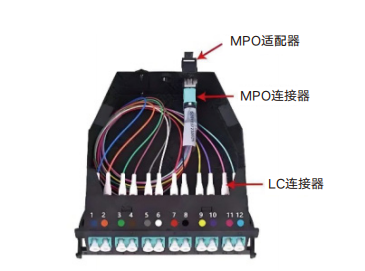
Inside the data center the constraint changes from environmental protection to loss budget and density. The MTP/MPO fan-out pre-terminated cable — models MTP-12F-to-6xLC-Duplex and MTP-24F-to-12xLC-Duplex — takes one multi-fibre ferrule and splits it into individual duplex connectors. The 12-fibre version breaks out to six LC duplex pairs; the 24-fibre version to twelve. Breakout options are LC or SC, duplex or quad.
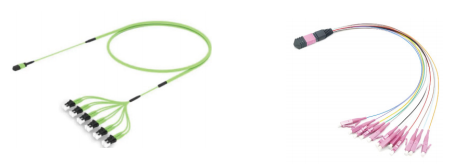
Supplied optical figures are the planning inputs:
- Insertion loss, standard grade: 0.35 dB typical, 0.75 dB maximum.
- Insertion loss, low-loss grade: 0.10 dB typical, 0.35 dB maximum.
- Return loss: ≥60 dB (APC), ≥50 dB (PC).
- Fibre count: 12F or 24F. Jacket: LSZH or OFNR. Fibre: OM3/OM4/OM5 multimode or OS2/G.657A single-mode. Ferrule: ceramic.
The decision rule that matters is to budget with maximum values, not typicals. A channel designed around 0.10 dB typical will not close on a 0.75 dB maximum unit. When a link contains several mated points — trunk, adapter, breakout — the grade decision has to be made once for the whole path rather than component by component, because every mated point adds its own loss and the weakest grade sets the outcome.
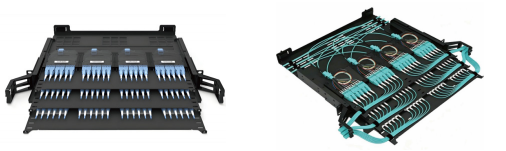
The stated application is cabinet interconnection and 40G/100G/400G SR4/PSM4 module connection. In practice that means the assembly is specified together with the patch panel and adapters on the same frame, and polarity is agreed before the first cable is pulled.
MPO/MTP loopbacks for equipment validation and commissioning
An MPO/MTP loopback returns transmit to receive at the same port. The supplied models are MPO-12F-Loopback and MPO-24F-Loopback, built with a ceramic/MTP ferrule, plastic housing and fibre cable, and applied to network testing, data center commissioning and equipment validation.
Published figures: insertion loss ≤0.7 dB for 8F/12F and ≤1.0 dB for 24F; return loss ≥65 dB (single-mode) and ≥25 dB (multimode); fibre types OS2/OM1/OM2/OM3/OM4/OM5; mating cycles ≥100,000; link failure rate <0.1%.
Two properties deserve attention. First, the loopback loss figure is a test-path figure, specified higher than a breakout's insertion loss. Using a loopback result to certify an installed channel would consume margin the channel does not actually have, so commissioning records should separate “port validated” from “channel loss measured”. Second, return loss behaves very differently by fibre type — ≥65 dB on single-mode against ≥25 dB on multimode — so every test record needs the fibre type attached to it, or the numbers cannot be compared later.
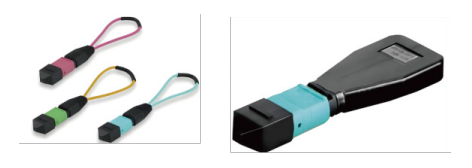
The ≥100,000 mating cycle rating is useful for a shared test kit that moves between cabinets and sites across a commissioning cycle. It is a rating, not an exemption from routine care: end-faces still need inspection and cleaning, and a loopback that has been dragged across a floor should be re-checked before it is trusted for acceptance work.
Step-by-step: seven checkpoints across both project types
1. Split the scope and the budget before tendering
List which links are outdoor plant and which are indoor channels, and keep two separate acceptance documents. Cable attenuation in dB/km and assembly insertion loss in dB are different measurements taken with different instruments; a single combined “loss” target invites the confusion described earlier.
2. Confirm installation conditions and cable configuration
Fix duct, aerial, burial or harsh-exposure installation per span, then lock fibre type, core count, sheath, armoring requirement and labelling. At this point commercial parameters apply: minimum order quantity for the cable range is 1 core kilometre, and monthly capacity is reported at 250,000 core kilometres.
3. Plan splicing, closures and distribution hardware together with the cable
Splice closures, FTTH distribution boxes, patch panels and connectors are the matched equipment for this layer. Approving the cable and the closure as one package prevents discovering a sealing or bend-radius mismatch on site.
4. Test and record the outdoor link before handover to the DC team
Measure attenuation at the operating wavelengths, file splice and closure records, and keep the sealing and mechanical evidence for the environment actually installed. Record the model and drum details with the results, so a later query can be traced to a specific delivery.
5. Fix polarity and adapter grade before installing breakouts
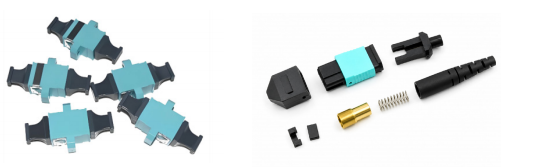
The MPO-12F-SM adapter carries insertion loss of standard <0.5 dB or low-loss <0.35 dB, return loss ≥50 dB on single-mode, 500 mating cycles (IEC compliant) with an operating range of −40 °C to +85 °C, and is offered across 4–72F single-mode and multimode. Adapter loss adds to the channel, so grade the adapter and the breakout with the same decision. Note that 500 mating cycles for an adapter and ≥100,000 for a loopback are different components with different ratings; neither figure transfers to the other.
6. Run the commissioning sequence with loopbacks
Validate equipment and ports with the loopback first, then measure the installed channel with the appropriate test method. Keep the two result sets in separate tabs of the commissioning report — one proves the port works, the other proves the path meets its budget.
7. Assemble the handover file
The file should contain: the approved datasheet for each model supplied; attenuation records for cable; insertion loss and return loss records for breakouts, adapters and loopbacks with loss grade noted; polarity documentation; certificate copies with scope and validity dates; and the labelling scheme as installed.
Where each item fits: four project patterns
- 5G backhaul and metropolitan backbone. GYTA53 cable over duct, aerial or buried routes, terminated through splice closures and distribution hardware, with attenuation and sealing records as the acceptance evidence.
- Data center cabinet interconnection at 40G/100G/400G. MTP/MPO fan-out pre-terminated cables between trunk and modules, graded for loss, with adapters on the same frame graded to match.
- Equipment validation and incoming inspection. MPO/MTP loopbacks on modules and ports, using the 12F or 24F version to match the port configuration under test.
- Enterprise campus, FTTx and industrial or smart city sites. Cable routed through harsher environments where waterproof sealing, rodent protection and temperature resistance join attenuation as acceptance criteria.
In every pattern the same discipline holds: the cable is judged on transmission and protection, the assembly on loss, and the loopback on port continuity.
Comparison: what each component proves, and what it does not
| Component | Project role | Supplied figures to plan with | Boundary condition |
|---|---|---|---|
| GYTA53 optical fiber cable (outdoor armored) | Transmission path for 5G backhaul, metro backbone, FTTx, campus and industrial routes | Fibre type G.652/G.657, core count, attenuation in dB/km, operating wavelengths, minimum bend radius, tensile strength, sheath material, environmental rating — confirmed per model datasheet | Attenuation and mechanical values are datasheet-specific; a value from another construction cannot be carried over |
| MTP/MPO fan-out pre-terminated cable (MTP-12F-to-6xLC-Duplex / MTP-24F-to-12xLC-Duplex) | Cabinet interconnection and 40G/100G/400G SR4/PSM4 module connections | IL 0.35 dB typical / 0.75 dB max (standard); 0.10 dB typical / 0.35 dB max (low-loss); RL ≥60 dB APC, ≥50 dB PC; 12F or 24F; LC/SC duplex or quad breakout | Budget with maximum values; a typical figure is not a limit |
| MPO/MTP loopback (MPO-12F-Loopback / MPO-24F-Loopback) | Equipment validation, data center commissioning, network testing | IL ≤0.7 dB (8F/12F), ≤1.0 dB (24F); RL ≥65 dB SM, ≥25 dB MM; mating cycles ≥100,000; link failure rate <0.1% | A test accessory: proves port continuity, not installed channel loss |
| MPO fiber optic adapter (MPO-12F-SM) | Mating point at patch panels and high-density frames | IL standard <0.5 dB, low-loss <0.35 dB; RL ≥50 dB (SM); 500 mating cycles (IEC compliant); −40 °C to +85 °C; 4–72F SM/MM | Adapter loss adds to the channel and must be graded with the breakout |
Acceptance checks: how to use certificates and test records
Nanfang Communication reports the following management-system certifications and accreditations: ISO 9001 quality management, TL9000 telecommunications quality management (TL9000-H is the hardware scope cited for its optical cable manufacturing), ISO 14001 environmental management, OHSAS 18001 occupational health and safety management, ISO 50001 energy management, and CNAS laboratory accreditation. The company also reports more than 300 patents including over 45 invention patents, participation in 16 standards (1 national, 15 industry), and National-level Green Factory designation.
These are process evidence. They support a conclusion that the factory operates controlled incoming inspection, in-process control and finished-product testing — including optical loss and attenuation tests, mechanical performance checks, and waterproof and sealing tests supported by laboratory capability — but they do not state a numeric value for any delivered item.

A practical acceptance sequence looks like this:
- Check scope, not the logo. Does the certificate name the product family and the manufacturing site that will supply the order?
- Check validity. Management-system certificates carry validity periods and can be revised. Where a tender specifies a particular occupational health and safety standard, confirm which certificate is currently held and in scope — certificate families and versions change over time, and a tender clause from an older template may not match the current document set. Ask for the current copies rather than relying on a brochure page.
- Separate certificates from test records. Ask for attenuation records at the operating wavelengths for cable, and insertion loss and return loss records with the loss grade stated for assemblies.
- Name the test method where the specification is technical. IEC 60794-1-104:2024, for example, defines impact test procedures for optical fibre cables; asking for results mapped to a named method is a different request from asking whether the supplier is “certified”.
- Match the record to the delivery. Model, loss grade, fibre type and quantity should appear on the same document, so a later query about a rack or a span can be traced.
Limitations and planning boundaries
- Family data is not a datasheet. GYTA53 specifications must be confirmed per model. Core count, fibre type, attenuation, bend radius and tensile strength are order-specific.
- Lead time is not a fixed number. It depends on model and quantity: samples and small orders typically take several weeks, while large orders may take months. Confirm before committing a commissioning date.
- Capacity and MOQ are commercial inputs. Monthly capacity of 250,000 core kilometres and a 1 core kilometre minimum order quantity are company-reported figures for the cable range; assembly quantities should be agreed separately.
- Export coverage should be checked per destination. The listed export markets are China's Hong Kong and Southeast Asia; buyers elsewhere should confirm shipping, documentation and tender eligibility before specifying.
- Operator cooperation is participation, not a performance guarantee. Reported long-term cooperation with China Mobile, China Telecom and China Unicom, and the company's stated contribution to network reliability and capacity across FTTx, metro and backbone, data center interconnect, 5G backhaul and campus cabling, describes involvement over 30 years. It is not a measured outcome for a future project.
- Test accessories have their own loss. Loopback insertion loss of ≤0.7 dB or ≤1.0 dB belongs in the test report, not in the channel budget.
Frequently asked questions
Which certificates and test records should be in the acceptance file for GYTA53 cable and MPO assemblies?
Keep two sets. The first is management-system evidence from the manufacturer: ISO 9001, TL9000 (TL9000-H for optical cable hardware), ISO 14001, OHSAS 18001 occupational health and safety, ISO 50001 energy management, and CNAS laboratory accreditation, as reported by Nanfang Communication. The second is product evidence: attenuation at the operating wavelengths for cable, insertion loss and return loss with the loss grade stated for breakouts, adapters and loopbacks, plus sealing and mechanical evidence for outdoor cable. Check that each certificate names the product family and site, that validity dates are current, and that each test record matches the model, fibre type and grade ordered. A certificate never states attenuation or insertion loss, so it cannot replace a test record.
Can one supplier deliver the cable, the breakouts and the loopbacks for the same project, including customization?
In the supplied product set they come from the same manufacturer: GYTA53 optical fiber cable, MTP/MPO fan-out pre-terminated cables in 12F and 24F, and MPO-12F/24F loopbacks, alongside indoor and outdoor cable, PLC splitters, fibre optic connectors, MPO multi-core connectors and optical modules. Customization covers core count, fibre type including single-mode, multimode, ribbon and multi-core, sheath material and colour, connector types and cabling schemes, and labelling and packaging; production modes include ODM/OEM, engineering design and system integration. Verify that the specific customization you need falls inside that list, and approve a drawing or specification sheet before production rather than after.
What drives the cost of a low-loss MPO breakout compared with a standard-loss assembly?
Within the supplied data, the clearest driver is the loss grade: standard grade is specified at 0.35 dB typical and 0.75 dB maximum, low-loss at 0.10 dB typical and 0.35 dB maximum, which are different builds rather than a sorting step with no cost effect. Other drivers are fibre type (OM3/OM4/OM5 multimode versus OS2/G.657A single-mode), 12F versus 24F construction, breakout count and connector style (LC or SC, duplex or quad), and jacket choice between LSZH and OFNR. For cable, core count, fibre type, sheath and armoring drive the comparison. Because no price is published, the useful comparison is channel cost rather than unit price: count the mated points in the link, then decide whether both the adapter and the breakout need the low-loss grade, or whether only one of them does.
How should a sample or pilot be planned before a full rollout?
Use one link, one cabinet and one loopback kit as the pilot unit. Write the loss budget with maximum values first, then order sample quantities — samples and small orders typically take several weeks according to the company. Test insertion loss and return loss on the breakout, the adapter and the loopback, record the fibre type with each result, and run a commissioning loopback on one module or port to confirm the port-level workflow. Compare measured values with the declared limits, and only then scale. Because the 1 core kilometre minimum applies to the cable range, confirm assembly sample quantities with the supplier at the same time.
What lead time should be planned, and how do we lock it?
There is no single published lead time: it depends on model and quantity, with samples and small orders typically taking several weeks and large orders potentially taking months. Plan backwards from the commissioning date, place the cable order before the data center fit-out begins so that route testing can finish early, reserve loopback kits and adapters before commissioning rather than during it, and keep a buffer for retesting or replacement of any assembly that fails end-face inspection. Confirm the schedule in writing with sales at order placement. To start that conversation, request a quotation or sample through Nanfang Communication, and the MPO and connectivity range is summarised in the Nanfang Communication MPO product brochure (PDF).
Conclusion
Adapting optical fiber cable and MPO accessories to a 5G backhaul or metropolitan backbone project and a data center fit-out is less about new products than about keeping three evidence trails separate. GYTA53 cable is proven by attenuation, sealing and mechanical records against the environment it is installed in. MTP/MPO fan-out pre-terminated cables are proven by insertion loss and return loss against a budget built on maximum values, with adapters graded to match. MPO/MTP loopbacks are proven by port-level validation during commissioning, with their own loss recorded as a test figure.
Once those trails are separated, the commercial questions become straightforward: which loss grade the channel actually needs, which customization items are fixed before production, and which certificate scopes and test records belong in the handover file. Those are the checks that decide whether a project is accepted on evidence or reworked on site.
Have Questions or Need More Details?
Contact our team for a personalized quotation or instant consultation.
Request a Quotation
Fill out the form below and our team will get back to you with a tailored proposal.
WhatsApp Direct Chat
Prefer to chat in real-time? Message us on WhatsApp for instant assistance & quick answers.
- Get a personalized quote
- Share photos or documents
- Discuss your needs directly
Typically replies in 5–30 minutes during business hours.