
MPO Fiber Optic Adapter: Standard or Low-Loss Grade for Your Project?
For the MPO-12F-SM adapter, the gap between the standard grade and the low-loss grade is one published figure: maximum insertion loss is <0.5 dB on the standard grade and <0.35 dB on the low-loss grade. Return loss (≥50 dB on single-mode), mating durability (500 mating cycles) and construction (ceramic ferrule, plastic housing, metal flange) are identical on both. The decision is a link-budget and verification question, not a quality ranking.
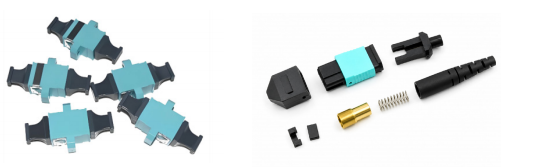
This guide is written for data center and telecom buyers who are already shortlisting MPO connectivity for an optical fiber cable project and now have to commit to a grade. It compares the two options against the specification that Nanfang Communication publishes for its MPO-12F-SM adapter, then converts that specification into selection steps, acceptance criteria and a comparison table that can be carried into a tender clarification or an internal design review.
Nanfang Communication (Jiangsu South Communication Technology Co., Ltd.) is a Jiangsu-based manufacturer founded in 1992 that produces optical fiber, optical cable, ODN systems and optical components — including MPO multi-core connectors, MT-FA series passive components and PM FA fiber arrays — and is a subsidiary of the Hong Kong-listed Nanfang Communication Holdings Limited (Stock Code: 1617.HK). Its MPO Fiber Optic Adapter, model MPO-12F-SM, is the reference product used throughout this comparison.
Problem Definition: Why the Grade Decision Is Harder Than the Datasheet Suggests
The two grades are mechanically interchangeable. They mount the same way, mate with the same MPO connectors and fit the same panel cut-outs. Once installed in a high-density patch panel, the grade survives only in labels, lot records and test reports — not in appearance. That is the first reason the choice deserves its own step in the project plan rather than a single line on a purchase order.
The second reason is accumulation. Every adapter in a channel introduces one mated pair, and each mated pair consumes part of the optical link budget. A channel that passes through several patch panels, a cross-connect and an equipment adaptor accumulates several loss ceilings. The difference between the two grade ceilings is small per pair and materially larger when it is multiplied across a long channel or a densely populated panel.
The third reason is verification. A ceiling of <0.35 dB can only be enforced if the acceptance test method and the reference-grade test cords can resolve it. A buyer who specifies the low-loss grade but accepts the same test procedure used for standard grade ends up paying for a specification that cannot be proven at goods-in.
The fourth reason is documentation. If a purchase order says only MPO adapter without stating an insertion-loss grade, either grade satisfies the wording. Grade has to appear in the specification, the quotation line item and the inspection record before it means anything commercially.
Industry Background: Why Adapter Grade Now Sits Inside Cable Project Decisions
Optical connectivity is no longer a minor accessory line inside a cable project. The global fiber optic cable market was valued at USD 14.6 billion in 2025, according to Global Market Insights, and China was the leading exporter of optical fibers and cables in 2024, with exports totaling USD 2.52 billion under HS 854470, according to the Observatory of Economic Complexity. As multi-fiber termination spreads through data centers and telecom plants, the adapter that joins two MPO connectors shifts from a consumable to a specified component.
Cost has also entered the grade conversation. Optical fiber cables of Chinese origin faced a total U.S. import duty of 37.50% under HTS 8544.70.00 as of late 2026, according to Airlift USA. For North American projects, landed cost now competes with optical margin for attention, which makes a deliberate grade choice more valuable than a default one.
Standards context shapes the surrounding specification even where it does not set adapter grades directly. ITU-T L.103 (08/2024) describes characteristics, construction and test methods for optical fibre cables for indoor applications; IEC 60794-1-104:2024 defines the impact test procedure (method E4) for optical fibre cables; IEC 60092-378:2024 covers optical fibre cables for shipboard and offshore fixed installations. A buyer who has already fixed the cable family and the test regime for the plant should make the adapter grade consistent with the loss budget that regime implies.
Detailed Solution: The Two MPO-12F-SM Grades, Specification by Specification
Nanfang Communication's MPO Fiber Optic Adapter (model MPO-12F-SM) is a 12-fiber single-mode adapter supplied in a standard grade and a low-loss grade. Both grades share the same published body specification; only the insertion-loss ceiling changes.
| Specification | Standard grade | Low-loss grade |
|---|---|---|
| Maximum insertion loss | <0.5 dB | <0.35 dB |
| Return loss (single-mode) | ≥50 dB | ≥50 dB |
| Mating cycles | 500 | 500 |
| Ferrule | Ceramic | Ceramic |
| Housing | Plastic | Plastic |
| Flange | Metal | Metal |
| Color options | Black, Aqua (OM3), Violet (OM4) | Black, Aqua (OM3), Violet (OM4) |
Insertion loss: the only real differentiator
Insertion loss is the signal energy lost at the mated pair. The standard grade is specified at a maximum of <0.5 dB; the low-loss grade at a maximum of <0.35 dB. Both numbers are ceilings rather than typical values, and a ceiling is the correct figure for a buyer to compare because it is the number an acceptance test can enforce. A supplier that quotes a typical value instead of a maximum leaves the buyer without a pass or fail criterion.
Because the difference is expressed in tenths of a decibel, it is easy to dismiss. It should instead be read against the count of mated pairs: the grade ceiling applies to each adapter, not to the whole channel, so the cumulative effect depends on how many adapters the signal crosses before it reaches the receiver.
Return loss: unchanged across grades
Return loss is specified at ≥50 dB for single-mode on both grades. Because this figure does not move with grade, reflection performance is not a reason to upgrade — and not a reason to relax inspection either. Return loss should be verified on every delivered lot regardless of which grade was purchased, since the specification is identical and the risk of a handling or cleaning defect is identical.
Mating cycles: 500 on both grades
Both grades are rated for 500 mating cycles. The rating matters most where adapters are re-mated repeatedly — staging areas, test laboratories, demonstration racks and temporary infrastructure — and least in a permanently patched panel that is connected once during commissioning. Because the rating is identical across grades, a project that needs durability does not automatically need the low-loss grade, and a project that needs the low-loss grade should still confirm the cycle rating rather than assume it improves with grade.
Construction: ceramic ferrule, plastic housing, metal flange
The ceramic ferrule is the alignment element that centres the fiber array, and ceramic is used for dimensional stability under repeated mating. The plastic housing carries the connector interface and retains the internal assembly. The metal flange provides the mechanical fixing point, which is the part that matters in high-density panels where adapters are stacked in rows and screwed to a panel face. Because all three elements are common to both grades, panel fit, latch feel and mechanical retention should not be used as a tie-breaker between standard and low-loss.
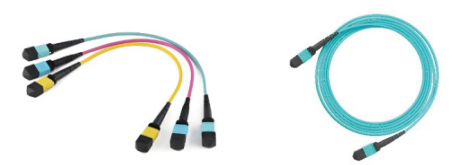
Color options and panel practice
The adapter family is available in Black, Aqua (OM3) and Violet (OM4). Color is used in panel practice as a visual cue during patching and maintenance, but color alone is not a performance statement: two adapters of the same color can carry different insertion-loss grades. Record the grade in the label, the as-built drawing and the inspection record rather than relying on the color scheme.
Step-by-Step Breakdown: Selecting the Grade for a Project
- Count the mated pairs in the channel. Trace the path from equipment port to equipment port and count every adapter the signal passes through. That count, not the number of panels ordered, determines how much loss the adapters are allowed to consume.
- Write the ceiling into the specification. State maximum insertion loss per mated pair as either <0.5 dB (standard grade) or <0.35 dB (low-loss grade). A specification without a number cannot be inspected at goods-in.
- Confirm the return-loss requirement. For single-mode, both grades publish ≥50 dB. Keep the requirement in the document even though grade does not change it, because it still has to be tested.
- Match the mounting to the panel. Check metal-flange fixing and adapter pitch against the MPO high-density patch panel that will receive the adapters, and confirm the plastic housing clears adjacent hardware and cable management.
- Decide the acceptance method before ordering. Choose between per-unit verification, lot sampling and third-party verification, and name the instrument class and reference cords. The method must be able to resolve the ceiling that was specified.
- Validate on a sample. Measure insertion loss and return loss on the delivered sample, confirm color and construction, and — where the adapters will be re-mated — run mating cycles up to the 500-cycle rating.
- Collect compliance documents and lock commercial terms. Obtain the certificate set, confirm that the grade appears on the quotation line item, and agree the delivery schedule in writing.
Acceptance Criteria and Certification Evidence
Acceptance for an MPO-12F-SM adapter should test three things and document one.
- Insertion loss verification against the grade ceiling: <0.5 dB for standard grade, <0.35 dB for low-loss grade.
- Return loss verification at ≥50 dB for single-mode.
- Mating durability where relevant: the 500-cycle rating is the reference point, and re-mating environments should be tested rather than assumed.
- Documentation: the grade stated on the packing list and inspection record, plus the supplier's management-system certificates.
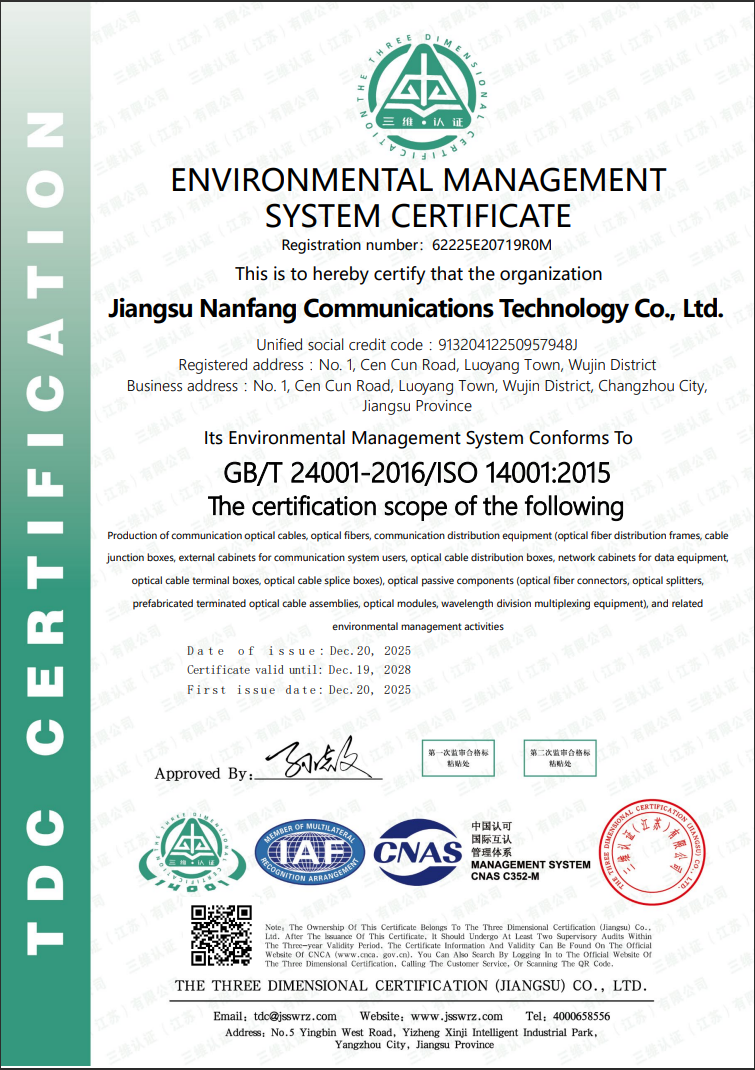
For Nanfang Communication, the document set includes an ISO 14001:2015 Environmental Management System certificate (certificate number 62225E20719R0M, issued 2025-12-20 by SWR Certification (Jiangsu) Co., Ltd., valid to 2028-12-19). Its certified scope covers production of communication optical cables, optical fibers and communication distribution equipment including ODF, cross connection cabinets, outdoor cabinets for communication systems, fiber distribution boxes and network cabinets for data equipment. The company also holds TL9000-H certification (certificate 15/25T15218R11, valid to 2028-10-19) for manufacture and sales of communication optical fiber cable, and ISO 45001:2018 certification (certificate 62225S20720R0M, valid to 2028-12-19).
One limit should be stated plainly: ISO 14001:2015 is an environmental management certificate, not a product-performance certificate. It evidences how the site manages the environmental aspects of production; it does not prove an insertion-loss value. Optical evidence comes from test data, and Nanfang Communication's CNAS laboratory accreditation (CNAS L11717, accredited to ISO/IEC 17025:2017 and valid to 2030-11-29) covers optical fiber cable and optical communication component testing and calibration — the relevant competence for verifying adapter and cable optical parameters.
Use Cases: Where Each Grade Fits
Data center high-density patching
In a densely populated panel, adapters sit side by side and a single trunk route can cross several patch fields. That is the environment where the low-loss ceiling earns its place, because the number of mated pairs per channel is highest and panel space cannot easily be traded for extra loss. Where a channel terminates directly at an equipment port across one panel, the standard grade is usually sufficient, provided the link budget was calculated with the <0.5 dB ceiling rather than a typical value.
Telecom metro, backbone and 5G backhaul
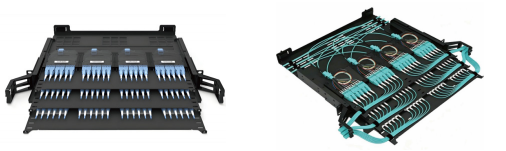
Nanfang Communication reports deployment of its optical fiber cable and connectivity products in FTTx access, metropolitan and backbone network construction, data center interconnects, 5G backhaul and enterprise campus cabling, with projects implemented in China for telecom operators, system integrators, contractors, data centers and enterprise customers. In these plants, adapter grade should follow the same logic as in the data center: count the mated pairs in the designed channel, then choose the ceiling that leaves margin for splice loss, cable attenuation and aging.
Enterprise campus cabling
Campus projects typically run fewer mated pairs per channel than a data hall and often accept a wider margin at design stage. The standard grade fits that profile, and the money is better spent on inspection discipline and on consistent labeling than on a tighter ceiling that the campus link does not need.
Test, staging and demonstration environments
Where adapters are mated and de-mated continuously, the 500-cycle rating becomes the operative specification rather than the grade. Both grades carry the same rating, so the selection question shifts to whether repeated handling is degrading return loss, which should be monitored rather than assumed.
Comparison Table: Standard vs Low-Loss at a Glance
The table below translates the published specification into a selection rule. The specification rows are factual; the selection column is guidance derived from how a link budget behaves, and should be confirmed against the project's own calculated margin.
| Project condition | Grade to shortlist | Reason |
|---|---|---|
| Few mated pairs per channel, margin calculated with a 0.5 dB ceiling | Standard (<0.5 dB) | The published ceiling already sits inside the calculated budget |
| Channel crosses multiple patch panels or a cross-connect | Low-loss (<0.35 dB) | Ceilings accumulate per mated pair across the channel |
| Specification or tender already states a per-pair ceiling below 0.5 dB | Low-loss (<0.35 dB) | The lower ceiling is the only compliant option |
| Adapters will be re-mated repeatedly (staging, laboratory) | Either grade | Both are rated for 500 mating cycles |
| Single-mode reflection control is the primary concern | Either grade | Return loss is ≥50 dB on both |
| Panel fixing and mechanical retention are the concern | Either grade | Ceramic ferrule, plastic housing and metal flange are common to both |
| Fiber type must be identifiable at the panel | Either grade | Both are offered in Black, Aqua (OM3) and Violet (OM4) |
Two limits belong with that table. First, a lower insertion-loss ceiling does not reduce the need for end-to-end channel testing; it only changes the allowance per mated pair. Second, grade selection does not remove the requirement to verify return loss, because that parameter is identical across grades and therefore tells you nothing about which grade was shipped.
Frequently Asked Questions
What certification evidence should a buyer request for an MPO fiber optic adapter?
Ask for the management-system certificates and for optical test evidence, and read them separately. Nanfang Communication holds an ISO 14001:2015 certificate (62225E20719R0M, issued 2025-12-20 by SWR Certification (Jiangsu) Co., Ltd., valid to 2028-12-19), a TL9000-H certificate (15/25T15218R11, valid to 2028-10-19) and an ISO 45001:2018 certificate (62225S20720R0M, valid to 2028-12-19). None of these proves an insertion-loss value: ISO 14001:2015 covers environmental management, TL9000-H covers the telecommunications quality management system, and ISO 45001:2018 covers occupational health and safety. Optical proof comes from test data, supported by the CNAS-accredited laboratory (CNAS L11717, ISO/IEC 17025:2017, valid to 2030-11-29) whose scope covers optical fiber cable and optical communication component testing and calibration.
Can one supplier deliver both grades plus customized configurations?
For Nanfang Communication, yes. The company manufactures and supplies the MPO-12F-SM adapter in both standard and low-loss grades and lists MPO multi-core connectors, MT-FA series optical passive components and PM FA fiber arrays within its optical component portfolio, alongside indoor and outdoor optical cables, PLC splitters, fiber optic connectors and optical modules. Customizable items include core count, fiber type (single-mode, multimode, ribbon or multi-core), sheath material and color, connector types and cabling schemes, labeling and packaging. The manufacturing base covers 26,795.3 m² with 360 employees and 80 R&D engineers, and reports monthly capacity of 250,000 core kilometers against annual output of 3,000,000 core kilometers.
How should the grade decision be budgeted?
Budget the decision as three cost lines rather than one unit price. The first is the adapter itself, where the grade must be stated on the quotation line item so the offer is comparable. The second is verification: a <0.35 dB ceiling costs more to prove than a <0.5 dB ceiling because the test method and reference cords must resolve it. The third is landed cost, which for North American buyers can include duty — Chinese-origin optical fiber cables faced a total U.S. import duty of 37.50% under HTS 8544.70.00 as of late 2026, per Airlift USA. Prices are not published in this guide, so request a quotation that names the grade, the quantity, the color and the acceptance method in the same document.
How should a sample be validated before the order is released?
Validate the sample against the same criteria that will be used at goods-in. Measure insertion loss against the purchased ceiling (<0.5 dB standard or <0.35 dB low-loss), verify return loss at ≥50 dB for single-mode, confirm the ceramic ferrule, plastic housing and metal flange visually, and check the color against the panel scheme. If the adapters will be re-mated in service, run mating cycles up to the 500-cycle rating and re-measure afterwards. If the project requires independent evidence, route the sample through a CNAS-accredited laboratory covering optical communication component testing and calibration.
What lead time and minimum order should be planned?
Lead time depends on model and quantity. Samples and small orders typically take several weeks, while large orders may take months, so the schedule should be confirmed with sales rather than assumed from a catalogue. The published minimum order quantity of 1 core kilometer applies to cable orders; adapter quantities and grade mix should be confirmed in the same conversation. Nanfang Communication can be reached at info@jsnfgroup.com or +86 51988792646, and a sample or quotation request that states the grade, mated-pair count and acceptance method will produce a faster and more comparable answer.
Conclusion: Decide on Mated Pairs, Then Verify
The standard and low-loss MPO-12F-SM adapters are the same product with two different insertion-loss ceilings: <0.5 dB and <0.35 dB. Return loss at ≥50 dB for single-mode, 500 mating cycles, the ceramic ferrule, plastic housing, metal flange and the Black, Aqua (OM3) and Violet (OM4) color options are common to both. That symmetry is the point: the grade decision should be made on the number of mated pairs in the channel and on the ability of the acceptance test to prove the ceiling — not on the assumption that a lower number is always the better purchase.
For projects where the low-loss grade is specified, pair it with a test method that can resolve it and with documentation that names the grade at every handover point. For projects where the standard grade is specified, keep return-loss verification in the acceptance plan, because that parameter does not change with grade and is therefore the one that catches handling defects.
Nanfang Communication manufactures the MPO-12F-SM adapter in both grades at its Jiangsu facility, operates under ISO 14001:2015, TL9000-H and ISO 45001:2018 certification, and holds CNAS laboratory accreditation (CNAS L11717) covering optical fiber cable and optical communication component testing and calibration. Additional specification detail is available in the Nanfang Communication MPO catalogue (PDF), and the company profile is published at jsnfgroup.com.
Next Step: Sample or Quotation
State the grade you are evaluating, the number of mated pairs per channel and your acceptance method, and request a sample or quotation for the MPO-12F-SM adapter. Email info@jsnfgroup.com, call +86 51988792646, or message WhatsApp +8619850287785. Download the MPO product catalogue for the full adapter and connectivity range.

Have Questions or Need More Details?
Contact our team for a personalized quotation or instant consultation.
Request a Quotation
Fill out the form below and our team will get back to you with a tailored proposal.
WhatsApp Direct Chat
Prefer to chat in real-time? Message us on WhatsApp for instant assistance & quick answers.
- Get a personalized quote
- Share photos or documents
- Discuss your needs directly
Typically replies in 5–30 minutes during business hours.