Optical Fiber Cable Market in 2026: Trends, Supplier Evaluation Criteria, and How to Qualify a Manufacturing Partner
Optical Fiber Cable Market in 2026: Trends, Supplier Evaluation Criteria, and How to Qualify a Manufacturing Partner

The optical fiber cable market is expanding, and procurement teams are being asked to evaluate suppliers more carefully than ever. This guide gives you a market snapshot, a practical supplier qualification framework, and specific product and certification facts you can use during evaluation.
Why optical fiber cable procurement is becoming more strategic
Buyers today face a crowded supplier landscape. Many companies offer optical fiber cable, but their manufacturing depth, testing capability, and customization options differ widely. A wrong supplier decision can lead to higher attenuation, field failures, missed project deadlines, and costly rework.
In response, evaluation-stage buyers need a structured approach: define the deployment scenario, verify documented capabilities, and request evidence such as certifications, lab accreditation, and production data.
Market context and verified industry data
According to Custom Market Insights, the global optical fiber cable market was valued at approximately USD 13.45 billion in 2025 and is projected to reach USD 36.48 billion by 2034. China exported approximately USD 2.52 billion of optical fiber cables (HS 854470) in 2024, based on OEC data.
The related component market is also growing. The global fiber optic connector market was estimated at USD 11.2 billion in 2024, with LC connectors holding a dominant share of 35.43%. For high-density networks, the MPO fiber optic connector market is projected to grow at a CAGR of 13.6% through 2035, driven largely by AI compute clusters and hyperscale data centers. The fiber termination box market, important for FTTH distribution, was valued at USD 2.8 billion in 2025.
Standards also set the baseline. ITU-T G.652.D remains the industry standard for single-mode fiber, while ITU-T G.657 is the primary standard for bend-insensitive fibers used in FTTH. These standards should appear in the datasheets you review.
Detailed solution: six dimensions for evaluating an optical fiber cable supplier
Based on available manufacturing evidence, a reliable supplier should be assessed on six dimensions: manufacturing depth, quality system, product portfolio, customization, proof points, and after-sales support.
1. Manufacturing depth
Nanfang Communication, operated by Jiangsu South Communication Technology Co., Ltd., is a subsidiary of the Hong Kong-listed company South Communication Holdings Limited (Stock Code: 1617.HK). Founded in July 1992, the company reports a factory area of 26,795.3 square meters, 360 employees, an annual output of 3,000,000 core kilometers, and a monthly capacity of 250,000 core kilometers. A supplier with this scale is better positioned to stabilize supply and keep quality control in-house.
2. Quality system and laboratory verification
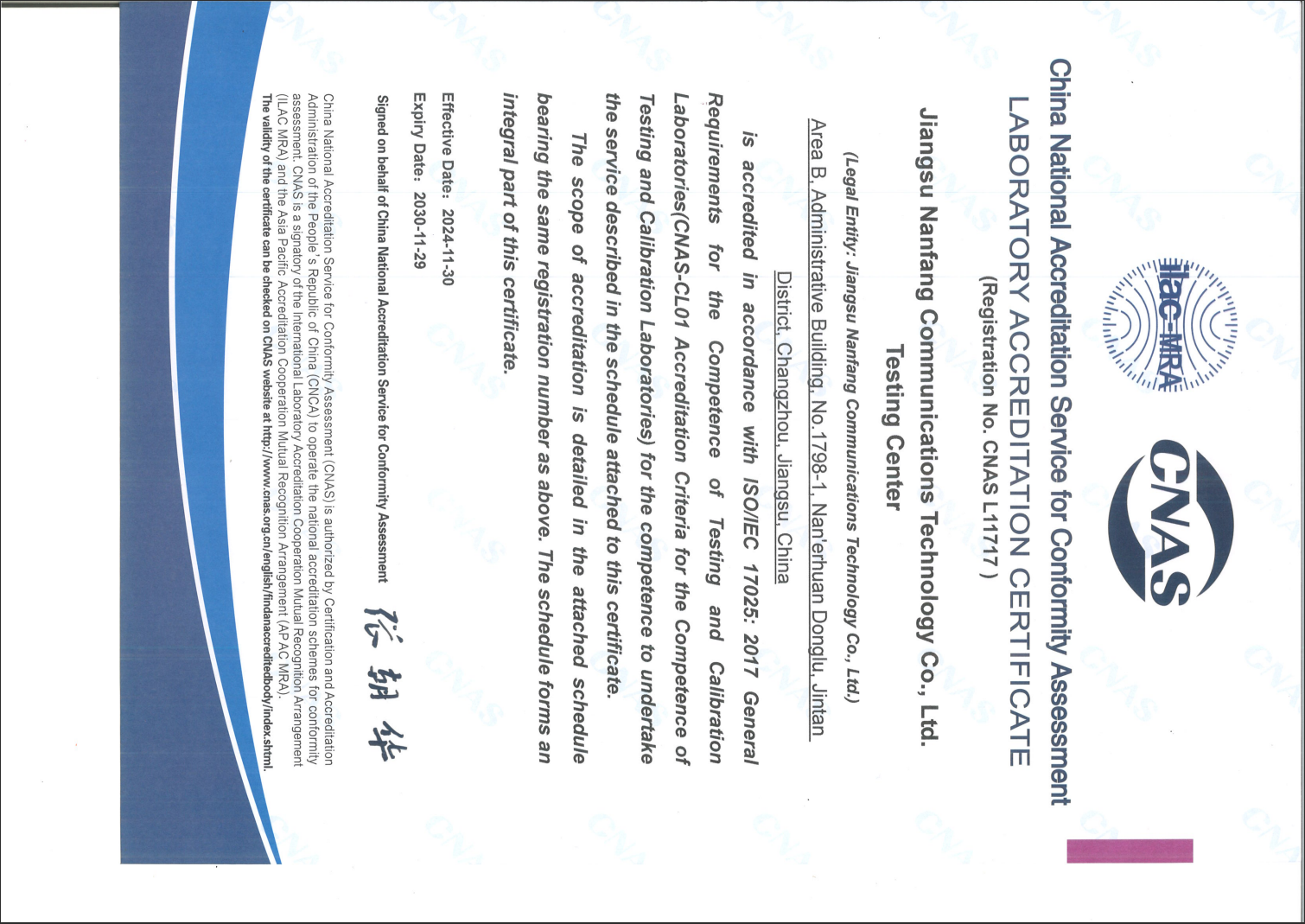
Certifications matter only when they are verifiable. Nanfang Communication has obtained certifications including ISO9001, TL9000, ISO14001, OHSAS18001 / ISO45001, ISO50001, and the Integration of Informatization and Industrialization Management System. It also operates a CNAS-accredited laboratory, certificate number CNAS L11717, covering optical fiber cable and optical communication component testing and calibration under ISO/IEC 17025:2017.
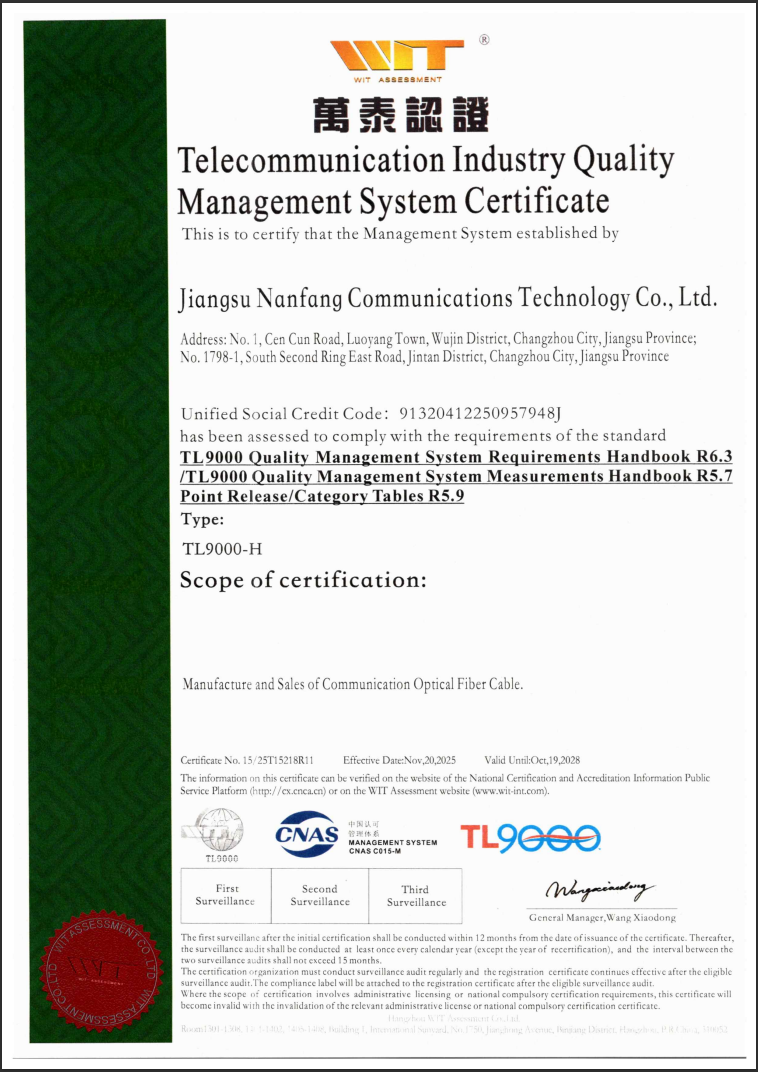
Specific management system certificates visible in the company's records include TL9000-H (certificate 15/25T15218R11, scope 'Manufacture and Sales of Communication Optical Fiber Cable') and ISO 45001 (certificate 62225S20720R0M). These documents provide auditable evidence of a quality management culture.
3. Product portfolio
An integrated portfolio reduces compatibility risk across a network. The company's main products include optical fibers, indoor and outdoor optical cables, PLC optical splitters, fiber optic connectors, MPO multi-core connectors, optical modules, and ODN systems and optical components. Related product types include bow-type drop optical cable, ribbon optical cable, loose-tube optical cable, single-mode and multimode fiber, MCF multi-core fiber, and MPO high-density patch panels.
4. Customization and engineering support
For project-specific needs, ask what can be adapted. Nanfang Communication customizes core count, fiber type (single-mode, multimode, ribbon, or multi-core), sheath material and color, connector types and cabling schemes, and labeling and packaging. It also offers ODM/OEM services and manufacturing, R&D, testing, engineering design, and system integration capabilities.
5. Proof points and track record
Look for deployment evidence. The company has been operating for 30 years. Its products have been used in FTTx access, metropolitan and backbone network construction, data center interconnects, 5G backhaul, and enterprise campus cabling. Client types include telecom operators such as China Mobile, China Telecom, and China Unicom, as well as system integrators, contractors, data centers, and enterprise customers. The company also serves private network users in high-speed rail, power grid, and chemical industries.
6. After-sales and service network
After-sales support should be part of the evaluation. Nanfang Communication reports that it provides technical support, a service network, and engineering support, supported by 28 provincial-level offices across China. For international buyers, the company lists Hong Kong and Southeast Asia among its export markets. Response times and warranty terms should be confirmed directly with the sales team.
Step-by-step supplier qualification process
Use this workflow when evaluating optical fiber cable suppliers.
- Define the deployment scenario and cable type: indoor cable, outdoor cable, bow-type drop cable, ribbon cable, or loose-tube cable; choose single-mode or multimode fiber and specify core count and attenuation requirements.
- Shortlist suppliers that manufacture, not merely resell, and hold relevant certifications.
- Verify certificates by asking for certificate numbers, issuing bodies, and scope. Confirm laboratory accreditation such as CNAS L11717.
- Assess customization capability with a technical questionnaire covering fiber type, sheath, connectors, termination, labeling, and packaging.
- Request a sample or small order. Nanfang Communication's MOQ is 1 core kilometer, which allows low-cost validation.
- Review the quality control process: incoming material inspection, in-process control, and finished-product testing for optical loss and attenuation, mechanical performance, and waterproof or sealing performance.
- Confirm lead time and logistics. Lead time depends on model and quantity; samples or small orders may take several weeks, while large orders may take months. Confirm all dates in writing.
Use cases: where these products are deployed
Optical fiber cable and ODN products support multiple network scenarios. Nanfang Communication's projects have been implemented in China and are used for FTTx access, metropolitan and backbone network construction, data center interconnects, 5G backhaul, and enterprise campus cabling. According to the company's case records, projects have achieved improved network reliability and capacity, supporting operators and industry clients' network buildouts.
Comparison table: supplier evaluation dimensions
| Evaluation dimension | What to check | Evidence to request |
|---|---|---|
| Manufacturing depth | Does the supplier produce fiber, cable, and ODN components? | Factory area, annual output, monthly capacity |
| Quality and laboratory | Does it hold management system certifications and operate an accredited lab? | ISO certificates, TL9000, CNAS number |
| Product portfolio | Can it cover indoor, outdoor, MPO, PLC, and ODN products? | Datasheets and samples |
| Customization | Can it adjust core count, fiber type, sheath, connectors, and packaging? | Customization list and engineering communication |
| Track record | Has it served telecom operators, data centers, and enterprise customers? | Case references and client types |
| Lead time and service | Can it meet sample and bulk delivery dates? | Written lead-time confirmation and service network |
FAQ
What certifications should an optical fiber cable manufacturer hold?
At a minimum, look for ISO9001 and, for telecom-heavy projects, TL9000. Environmental and occupational health certifications such as ISO14001 and ISO45001 show systematic management. A CNAS-accredited laboratory is a strong signal because it means the manufacturer can perform optical fiber cable testing and calibration in-house. For example, Nanfang Communication holds CNAS L11717.
What customization options are commonly available for optical fiber cable?
Common options include core count, fiber type (single-mode, multimode, ribbon, or multi-core), sheath material and color, connector types and cabling schemes, and labeling and packaging. Manufacturers with ODM/OEM capability can also support engineering design and system integration.
What factors affect the total cost of optical fiber cable procurement?
The main factors are fiber type, core count, sheath material, armoring, connector type, certification requirements, order volume, and lead time. Market demand for high-density components such as MPO connectors is rising, which can influence pricing. Exact pricing should come from the supplier based on your specification and quantity.
Can I request a sample or small order before placing a large order?
Yes. In many cases, sample or small-order validation is possible. Nanfang Communication sets an MOQ of 1 core kilometer, so you can test product quality, packaging, and documentation before scaling up.
How long does it take to receive optical fiber cable samples or bulk orders?
Lead time depends on model and quantity. Samples and small orders typically take several weeks, while large orders may take months. You should confirm the exact schedule with the sales team before placing an order.
Conclusion and next steps
Supplier evaluation in 2026 should be based on evidence: certifications, lab scope, production capacity, product portfolio, customization ability, and real project references. The optical fiber cable market continues to grow, but not every supplier can deliver the same level of verification. If you are evaluating a manufacturing partner, Nanfang Communication provides a useful benchmark with its 30-year history, Hong Kong listing, national-level laboratory, and integrated fiber/cable plus ODN capability.
To review product documentation, download the Nanfang Communication brochure. For sample requests, quotations, or technical inquiries, contact the team via email at info@jsnfgroup.com or WhatsApp at +86 19850287785.

Download the Nanfang Communication brochure
Have Questions or Need More Details?
Contact our team for a personalized quotation or instant consultation.
Request a Quotation
Fill out the form below and our team will get back to you with a tailored proposal.
WhatsApp Direct Chat
Prefer to chat in real-time? Message us on WhatsApp for instant assistance & quick answers.
- Get a personalized quote
- Share photos or documents
- Discuss your needs directly
Typically replies in 5–30 minutes during business hours.