Optical Fiber Cable: Matching Type to Deployment Scenario
Optical Fiber Cable: Matching Type to Deployment Scenario
Nanfang Communication is an optical fiber, optical cable, and ODN system manufacturer in Changzhou City, Jiangsu Province, China, and a subsidiary of the Hong Kong-listed company South Communication Holdings Limited (Stock Code: 1617.HK). For procurement teams in the Research and Evaluation phase, the practical question is not only which optical fiber cable to buy, but which cable construction fits which deployment scenario. This guide maps Nanfang Communication's optical fiber cable product line — indoor optical cable, outdoor optical cable, ribbon optical cable, loose-tube optical cable, and bow-type drop optical cable — to the project types where each construction is commonly specified, including FTTH/FTTx access, metropolitan and backbone networks, data center interconnects, 5G backhaul, and enterprise/campus networks.
Why scenario fit determines cable performance
Optical fiber cable acts as the physical-layer transmission and distribution infrastructure of a network, providing signal transmission, fiber distribution, and patching/access functions. It operates in long-term continuous mode as passive optical network components or as supporting physical channels for active equipment, requiring stable maintenance and periodic inspections. When the cable construction does not match the environment, this passive infrastructure becomes the most expensive layer of the network to repair or replace.
Deployment conditions differ significantly: indoor cabling, duct/ducting installation, aerial/self-supporting, direct burial, and outdoor harsh environments. Each condition imposes different demands, including weatherproofing, waterproofing, rodent protection, and temperature resistance. These requirements are common in China and globally, and they affect the choice of sheath, armoring, and strength members.
The project types that typically specify these cables include FTTH/FTTx access projects, metropolitan and backbone network projects, data center interconnects, operator network expansion and 5G backhaul projects, and enterprise/campus network deployments.
Industry context: optical fiber cable demand is expanding
The global optical fiber cable market was valued at approximately USD 13.45 billion in 2025 and is projected to reach USD 36.48 billion by 2034, according to Custom Market Insights. China exported approximately USD 2.52 billion of optical fiber cables (HS 854470) in 2024, according to the Observatory of Economic Complexity.
Two trends shape scenario requirements. The MPO fiber optic connector market is projected to grow at a CAGR of 13.6% through 2035, driven by AI compute clusters and hyperscale data centers, according to Business Research Insights. The global fiber termination box market — the segment covering FTTH distribution boxes — was valued at USD 2.8 billion in 2025, according to Dataintelo. Both trends point toward higher-density optical fiber cable systems that must still withstand field installation conditions such as weatherproofing, waterproofing, and mechanical protection.
On the standards side, ITU-T G.652.D remains the industry standard for single-mode fiber, while ITU-T G.657 is the primary standard for bend-insensitive fibers used in FTTH. These two standards anchor most scenario-specific fiber decisions.
Nanfang Communication's optical fiber cable portfolio
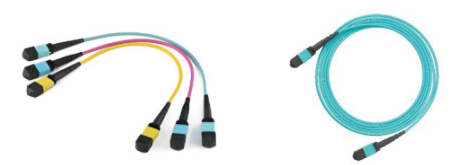
Nanfang Communication's optical fiber cable product line, referenced by model GYTA53, comprises multiple constructions within one system: indoor optical cable, outdoor optical cable, ribbon optical cable, loose-tube optical cable, bow-type drop optical cable, single-mode fiber, multimode fiber, and MCF multi-core fiber. The supporting ecosystem includes MPO high-density patch panels, PLC optical splitters, fiber optic connectors, optical cable splice closures, FTTH optical cable distribution boxes, optical modules, MT-FAU fiber optic assemblies, and WDM wavelength division multiplexers.
Material selection is a core part of scenario fit. Core materials are optical fiber (silica glass); sheaths are PE or LSZH; armoring is galvanized steel wire or steel tape; and strength members are FRP. Common parameters include fiber type (e.g., G.652/G.657), core count, core diameter, attenuation (dB/km), operating wavelengths, minimum bend radius, tensile strength, sheath material, and environmental ratings. Exact specifications must be confirmed per model datasheet.
Step by step: matching cable type to project scenario
Step 1: Define the installation environment
Determine whether the cable will be installed indoors, in duct/ducting, aerial/self-supporting, direct burial, or in outdoor harsh environments. Each environment sets baseline requirements for weatherproofing, waterproofing, rodent protection, and temperature resistance.
Step 2: Identify the special requirements
Scenario-critical optical cable projects commonly require low attenuation, low insertion loss, flame-retardant or LSZH sheaths, waterproof sealing, crush and tensile resistance, corrosion and weather resistance, and customizable core counts and labeling.
Step 3: Choose the fiber type
Single-mode fiber (G.652/G.657) is the standard for telecom and long-reach applications; G.657 bend-insensitive fiber is the primary FTTH fiber per ITU-T standards. Multimode fiber is used in shorter-reach links typical of data center environments. Ribbon fiber and MCF multi-core fiber support high-density and future-capacity designs.
Step 4: Select the cable construction
Loose-tube optical cable is commonly specified for outdoor duct and buried installations; bow-type drop cable is designed for the final drop section of FTTH; indoor optical cable addresses premises runs; and ribbon optical cable supports high fiber counts in backbone and data center feeds. Nanfang Communication supplies each construction and can integrate them into a common cabling scheme.
Step 5: Match connectors and supporting equipment
Scenario fit extends beyond the cable itself. Supporting devices used alongside Nanfang Communication's optical fiber cable include optical modules, PLC splitters, cable splice closures, FTTH distribution boxes, MPO patch panels, fiber optic connectors, MT-FAU fiber assemblies, and WDM units.
Step 6: Confirm quality and compliance
Nanfang Communication operates under ISO9001, TL9000, ISO14001, OHSAS18001, and ISO50001 management systems, and maintains a CNAS-accredited laboratory. Quality control covers incoming material inspection, in-process control, and finished-product testing, including optical loss/attenuation tests, mechanical performance, and waterproof/sealing tests.
Common deployment scenarios and recommended components
FTTH / FTTx access projects
FTTH/FTTx projects prioritize bend performance in the drop section and flame-retardant or LSZH sheaths where cable enters buildings. Bow-type drop cable and PLC optical splitters are the components most directly associated with this segment, and ITU-T G.657 bend-insensitive fiber is the FTTH standard for this application.
Metropolitan and backbone networks
Metropolitan and backbone projects specify outdoor cable with robust armoring. Loose-tube construction with galvanized steel wire or steel tape armoring, waterproof sealing, and crush/tensile resistance are typical of this segment. These networks require low attenuation over long spans and commonly use single-mode fiber.
Data center interconnects
Data center projects increasingly rely on MPO/MTP high-density systems. Nanfang Communication's MPO fiber optic adapter (model MPO-12F-SM) delivers standard insertion loss below 0.5 dB and low-loss below 0.35 dB, return loss ≥50 dB (SM), 500 mating cycles (IEC compliant), and operation from -40°C to +85°C.
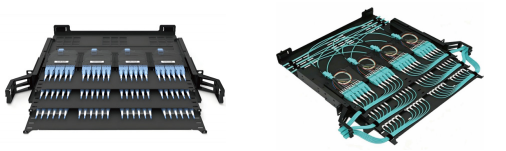
The MTP/MPO fan-out pre-terminated cable (MTP-12F-to-6xLC-Duplex / MTP-24F-to-12xLC-Duplex) targets data center cabinet interconnection and 40G/100G/400G SR4/PSM4 module connections. Typical insertion loss is 0.35 dB with a maximum of 0.75 dB; return loss is ≥60 dB (APC) or ≥50 dB (PC); fiber count is 12F or 24F; and jacket options include LSZH and OFNR.
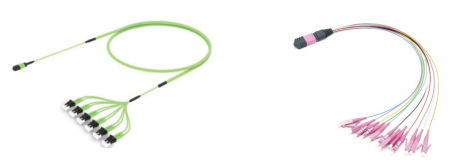
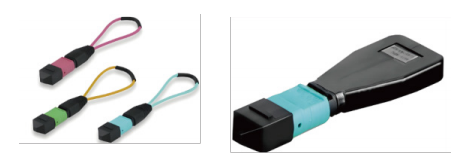
For commissioning and validation, the MPO/MTP loopback (MPO-12F-Loopback / MPO-24F-Loopback) supports network testing, data center commissioning, and equipment validation, with low-loss insertion loss ≤0.7 dB (8F/12F) or ≤1.0 dB (24F), return loss ≥65 dB (SM), ≥100,000 mating cycles, and a link failure rate below 0.1%.
5G backhaul and enterprise/campus networks
5G backhaul and enterprise campus projects combine indoor and outdoor sections, requiring a mix of cable constructions plus customizable core counts and labeling. Outdoor segments typically demand corrosion and weather resistance; indoor segments require flame-retardant characteristics.
Component-level comparison for scenario planning
| Component | Typical scenario fit | Key parameters |
|---|---|---|
| Optical fiber cable (GYTA53) | FTTH/FTTx, metropolitan/backbone, data center interconnects, 5G backhaul, enterprise/campus networks | PE/LSZH sheath; galvanized steel wire/steel tape armoring; fiber types include G.652/G.657; customizable core count and labeling |
| MPO fiber optic adapter (MPO-12F-SM) | Data centers, telecom networks, high-density cabling systems | IL <0.5 dB standard, <0.35 dB low-loss; RL ≥50 dB (SM); 500 mating cycles (IEC); -40°C to +85°C; 4-72F SM/MM |
| MTP/MPO fan-out pre-terminated cable | Data center cabinet interconnection; 40G/100G/400G SR4/PSM4 module connection | IL typ 0.35 dB, max 0.75 dB; RL ≥60 dB (APC), ≥50 dB (PC); 12F/24F; LSZH/OFNR jacket |
| MPO/MTP loopback | Network testing, data center commissioning, equipment validation | IL ≤0.7 dB (8F/12F), ≤1.0 dB (24F); RL ≥65 dB (SM); ≥100,000 mating cycles; link failure rate <0.1% |
Frequently asked questions
What special requirements do optical fiber cable projects typically impose?
Project scenarios in China and globally impose a consistent set of special requirements on optical fiber cable: low attenuation, low insertion loss, flame-retardant or LSZH sheaths, waterproof sealing, crush and tensile resistance, corrosion and weather resistance, and customizable core counts and labeling. Installation conditions range from indoor cabling and duct/ducting to aerial/self-supporting, direct burial, and outdoor harsh environments, with weatherproofing, waterproofing, rodent protection, and temperature resistance.
Which project types are Nanfang Communication's optical fiber cables suitable for?
Nanfang Communication's optical fiber cable is suitable for FTTH/FTTx access projects, metropolitan and backbone network projects, data center interconnects, operator network expansion and 5G backhaul projects, and enterprise/campus network deployments.
What cable and component types are available for scenario matching?
The product line includes indoor optical cable, outdoor optical cable, ribbon optical cable, loose-tube optical cable, bow-type drop optical cable, single-mode and multimode fiber, and MCF multi-core fiber. Supporting components include MPO high-density patch panels, PLC optical splitters, fiber optic connectors, MPO/MTP fan-out pre-terminated cables, MPO fiber optic adapters, and MPO/MTP loopbacks, complemented by optical cable splice closures, FTTH distribution boxes, MT-FAU fiber assemblies, and WDM units.
Can Nanfang Communication customize cables for a specific project?
Yes. Customizable items include core count, fiber type (single-mode, multimode, ribbon, multi-core), sheath material and color, connector types and cabling schemes, and labeling and packaging. Nanfang Communication provides manufacturing, R&D and testing, engineering design and system integration, and ODM/OEM services. Production capacity is 250,000 core kilometers per month, and quality control covers incoming material inspection, in-process control, and finished-product testing including optical loss/attenuation tests, mechanical performance, and waterproof/sealing tests.
What is the minimum order quantity and typical lead time?
The minimum order quantity is 1 core kilometer. Lead time depends on model and quantity. Samples and small orders typically take several weeks; large orders may take months. Exact timing should be confirmed with the Nanfang Communication sales team.
How can I request samples, a catalog, or a quote for my project?
Nanfang Communication accepts sample requests, quotation inquiries, and technical consultation. Contact the company by email at info@jsnfgroup.com, by phone at +86 51988792646, or via WhatsApp at +8619850287785. The company's product brochure is available for public download, and the company website provides additional contact options. Nanfang Communication maintains 28 provincial-level offices across China for localized sales, technical support, and after-sales service, and exports to China's Hong Kong and Southeast Asia regions. Buyers in the FTTH, data center, or 5G backhaul segment can request scenario-matched recommendations by sharing project details through the same channels.
Conclusion
Optical fiber cable selection is a scenario-matching exercise, not a one-specification decision. Nanfang Communication's integrated portfolio — spanning fiber, cable, and ODN components — allows project teams to specify construction, fiber type, and supporting hardware from a single manufacturer, with an operating history that dates to 1992, a CNAS-accredited laboratory, and an integrated fiber/cable/ODN value chain. For project teams in the Research and Evaluation phase, the practical next step is to map the deployment environment, confirm the special requirements, and request a scenario-matched quotation.
Download the Nanfang Communication product brochure
For a complete view of the optical fiber cable portfolio and MPO component offering, download the brochure or visit www.jsnfgroup.com.
Email: info@jsnfgroup.com | Tel: +86 51988792646 | WhatsApp: +8619850287785
Nanfang Communication, Changzhou City, Jiangsu Province, China
Have Questions or Need More Details?
Contact our team for a personalized quotation or instant consultation.
Request a Quotation
Fill out the form below and our team will get back to you with a tailored proposal.
WhatsApp Direct Chat
Prefer to chat in real-time? Message us on WhatsApp for instant assistance & quick answers.
- Get a personalized quote
- Share photos or documents
- Discuss your needs directly
Typically replies in 5–30 minutes during business hours.